



Learning Center

ComparePower 57500 5-Star Ratings Reviews

Any product or company names, marks, or logos shown on this page are the property of their respective owners. Compare Power is an unaffiliated, independent marketplace. Get unbiased, accurate information backed by our commitment to editorial integrity.

Find the Best Fixed Electric Rates

What’s a good fixed rate per kWh in Texas? The lowest fixed-rate electricity plan today starts at 12.30¢/kWh – significantly lower than the Texas average of 15.23 ¢/kWh.

A fixed-rate electricity plan in Texas locks in a set rate per kWh for the duration of your contract, typically 6 to 36 months, providing stability and predictable monthly bills.

Key Takeaways:

  • Fixed-rate plans offer price stability for the contract duration
  • Current fixed rates start as low as 12.30¢/kWh
  • Contract lengths vary from 6 to 36 months
  • Compare plans to find the best rate for your usage

Best Fixed-Rate Electricity Plans

Plan Name Plan Length Rate
Amigo Energy - Simply Days Free - 1212 months18.5¢ / kWh
Amigo Energy - Simply Days Free - 2424 months17.7¢ / kWh
Amigo Energy - Nights Free Plan - 1212 months18.7¢ / kWh
Amigo Energy - 12th Month Free - 1212 months18.7¢ / kWh
Amigo Energy - Secure Energy - 2424 months17.5¢ / kWh
Constellation - 12 Month (No Min Usage Fee)12 months16.3¢ / kWh
Constellation - 12 Month GREEN (No Min Usage Fee)12 months17.4¢ / kWh
Constellation - 12 Month GREEN Usage Bill Credit12 months15.7¢ / kWh
Constellation - 12 Month Usage Bill Credit12 months14.7¢ / kWh
Constellation - 12Mo Usage Bill Credit + A/C Protection for 1 Unit and HVAC Monitoring12 months15.3¢ / kWh
Constellation - 12Mo Usage Bill Credit + A/C Protection for 2 Units and HVAC Monitoring12 months15.3¢ / kWh
Constellation - 24 Month Usage Bill Credit24 months14.9¢ / kWh
Tara Energy - Value Wise - 1212 months14.3¢ / kWh
Tara Energy - Value Wise - 2424 months14.2¢ / kWh
Tara Energy - Weekends Free Plan - 2424 months17.5¢ / kWh
Just Energy - Mega Saver - 2424 months21.3¢ / kWh
Just Energy - Power Plus - 1212 months12.8¢ / kWh
Just Energy - Simple Choice - 1212 months18.3¢ / kWh
Just Energy - Basics - 1212 months18.4¢ / kWh
Just Energy - Basics - 2424 months17.5¢ / kWh
Just Energy - Power Plus - 2424 months12.5¢ / kWh
Just Energy - Simple Choice - 2424 months17.6¢ / kWh
4Change Energy - Cash Money 1212 months15.9¢ / kWh
4Change Energy - One Rate 1212 months16.7¢ / kWh
4Change Energy - Power Maxx Saver 1212 months18.1¢ / kWh
4Change Energy - Maxx Saver Select 2424 months10.6¢ / kWh
4Change Energy - One Rate 2424 months16.7¢ / kWh
4Change Energy - Power Maxx Saver 2424 months18.1¢ / kWh
4Change Energy - Power Savvy Saver 1212 months18.0¢ / kWh
Frontier Utilities - Frontier Saver Deluxe 1212 months20.1¢ / kWh
Frontier Utilities - Frontier Saver Plus 1212 months10.1¢ / kWh
Frontier Utilities - Frontier Saver Premier 1212 months20.2¢ / kWh
Frontier Utilities - Frontier Saver Value 1212 months20.3¢ / kWh
Frontier Utilities - Frontier Saver Value Plus 1212 months16.1¢ / kWh
Frontier Utilities - Frontier Straight Power $17512 months17.5¢ / kWh
Frontier Utilities - Light Saver 1212 months16.8¢ / kWh
Gexa Energy - Gexa Eco Saver Advantage 1212 months20.2¢ / kWh
Gexa Energy - Gexa Eco Saver Lite 1212 months20.4¢ / kWh
Gexa Energy - Gexa Eco Saver Plus 1212 months10.2¢ / kWh
Gexa Energy - Gexa Eco Saver Premier 1212 months20.2¢ / kWh
Gexa Energy - Gexa Eco Saver Value 1212 months16.1¢ / kWh
Gexa Energy - Gexa Light Saver 1212 months16.9¢ / kWh
Green Mountain - Pollution Free Conserve 12 Preferred12 months17.5¢ / kWh
Green Mountain - Pollution Free e-Plus 12 Preferred12 months17.8¢ / kWh
Green Mountain - Pollution Free Conserve 24 Preferred24 months17.5¢ / kWh
Green Mountain - Pollution Free e-Plus 24 Preferred24 months17.8¢ / kWh
Discount Power - Bill Credit Bundle 1212 months10.2¢ / kWh
Discount Power - Bill Credit Bundle 2424 months10.2¢ / kWh
Discount Power - Wise Buy Basic 24 Online24 months15.8¢ / kWh
Discount Power - Bill Credit Bundle 2000 kWh 1212 months20.7¢ / kWh
Discount Power - Essential Saver 1212 months15.9¢ / kWh
Discount Power - Bill Credit Bundle 2000 kWh 2424 months20.5¢ / kWh
Reliant - Reliant Basic Power 12 plan12 months17.8¢ / kWh
Reliant - Reliant Power Savings 12 plan12 months15.5¢ / kWh
Reliant - Reliant Basic Power 24 plan24 months17.2¢ / kWh
Reliant - Reliant Power Savings 24 plan24 months13.9¢ / kWh
Reliant - Reliant Conservation 12 plan12 months17.9¢ / kWh
Reliant - Reliant Power Savings 2,000 kWh 12 plan12 months22.3¢ / kWh
Reliant - Reliant Pure Power 12 plan12 months18.4¢ / kWh
Reliant - Reliant Conservation 24 plan24 months17.5¢ / kWh
Reliant - Reliant Power Savings 2,000 kWh 24 plan24 months20.7¢ / kWh
Reliant - Reliant Pure Power 24 plan24 months18.0¢ / kWh
Reliant - Reliant Truly Free Nights 100% Solar 12 plan12 months19.8¢ / kWh
Reliant - Reliant Truly Free Weekends 100% Solar 12 plan12 months19.8¢ / kWh
Cirro Energy - Simple Bill Credit 1212 months10.2¢ / kWh
Cirro Energy - Simple Bill Credit 2424 months10.2¢ / kWh
Cirro Energy - Smart Value 2424 months15.9¢ / kWh
Cirro Energy - Smart Value 1212 months16.5¢ / kWh
Cirro Energy - Simple Advantage 1212 months15.9¢ / kWh
Cirro Energy - Simple Bill Credit Bundle 2000 kWh 1212 months20.7¢ / kWh
Cirro Energy - Simple Advantage 2424 months15.9¢ / kWh
Cirro Energy - Simple Bill Credit Bundle 2000 kWh 2424 months20.5¢ / kWh
Direct Energy - Live Brighter Lite 1212 months15.5¢ / kWh
Direct Energy - Live Brighter 1K+ 2424 months17.8¢ / kWh
Direct Energy - Live Brighter Lite 2424 months15.9¢ / kWh
Direct Energy - Twelve Hour Power 1212 months22.6¢ / kWh
Direct Energy - Bright Secure 1212 months16.5¢ / kWh
Payless Power - 6 Month - Prepaid6 months19.0¢ / kWh
Payless Power - 12 Month - Prepaid12 months18.7¢ / kWh
TXU Energy - Flex Forward1 months19.0¢ / kWh
TXU Energy - Clear Deal 1212 months15.5¢ / kWh
TXU Energy - Live Your Free 1212 months20.2¢ / kWh
TXU Energy - Saver's Discount 1212 months21.7¢ / kWh
TXU Energy - Simple Rate 1212 months19.2¢ / kWh
TXU Energy - Clear Deal 2424 months16.5¢ / kWh
TXU Energy - Saver's Discount 2424 months22.9¢ / kWh
TXU Energy - Ultimate Season Pass 1212 months20.2¢ / kWh
TXU Energy - Solar Saver 1212 months20.9¢ / kWh
TXU Energy - Solar Value 1212 months16.9¢ / kWh
TXU Energy - Free Nights & Solar Days 12 (8 pm)12 months20.5¢ / kWh
Rhythm Energy - Rhythm Saver 1212 months10.1¢ / kWh
Rhythm Energy - Watt a Deal 1212 months18.7¢ / kWh
Rhythm Energy - Simply Green 1313 months17.8¢ / kWh
Rhythm Energy - Simply Green 2323 months17.6¢ / kWh
Rhythm Energy - Simply Secure 2424 months17.6¢ / kWh
APGE - Ultra Flex 11 months18.0¢ / kWh
APGE - True Simple 66 months16.6¢ / kWh
APGE - SimpleSaver 1212 months10.3¢ / kWh
APGE - True Simple 1212 months15.8¢ / kWh
APGE - SimpleSaver 1313 months10.3¢ / kWh
APGE - True Simple 1313 months15.9¢ / kWh
APGE - SimpleSaver 2424 months10.4¢ / kWh
APGE - True Simple 2424 months16.0¢ / kWh
APGE - SimpleSaver 3636 months11.0¢ / kWh
APGE - True Simple 3636 months16.3¢ / kWh
Atlantex Power - Luminous 1212 months16.3¢ / kWh
Atlantex Power - Radiance1000 1212 months12.3¢ / kWh
Atlantex Power - Radiance2000 1212 months22.6¢ / kWh
Atlantex Power - Luminous 2424 months16.5¢ / kWh
Atlantex Power - Radiance1000 2424 months12.5¢ / kWh
Atlantex Power - Radiance2000 2424 months22.8¢ / kWh
Atlantex Power - Luminous 3636 months16.5¢ / kWh
Atlantex Power - Radiance1000 3636 months12.6¢ / kWh
Atlantex Power - Radiance2000 3636 months22.9¢ / kWh
Atlantex Power - Luminous Nights 1212 months16.5¢ / kWh
Atlantex Power - Luminous Weekends 1212 months16.4¢ / kWh
Atlantex Power - Luminous Nights 2424 months16.6¢ / kWh
Atlantex Power - Luminous Weekends 2424 months16.6¢ / kWh
Atlantex Power - Luminous Nights 3636 months16.6¢ / kWh
Atlantex Power - Luminous Weekends 3636 months16.6¢ / kWh
Atlantex Power - Luminous Green 1212 months16.7¢ / kWh
Atlantex Power - Luminous Green 2424 months16.9¢ / kWh
Atlantex Power - Luminous Green 3636 months16.9¢ / kWh

These live rates for ONCOR ELECTRIC DELIVERY COMPANY service area were updated on . Pricing shown is based on an exact usage of 1000 kWh.

What are the benefits of fixed-rate electricity plans in Texas?

For Texans tired of volatile electricity bills, fixed-rate plans offer a simple solution – stability. By locking in a set rate for your contract term, you can say goodbye to unpredictable monthly costs and scream-worthy rate hikes.

No more budgeting headaches or bracing for sky-high summer bills. Just consistent, level payments you can plan around.

At its core, a fixed-rate electricity plan is elegant in its simplicity. You pay a locked rate per kWh of usage for the duration of your contract, whether six months, one year, two years, or more. Your rate doesn’t fluctuate with market conditions, utility fuel costs, or seasons.

Does it sound too good to be true? While fixed rates don’t protect you from changes in your usage patterns, they eliminate the chaos of rate volatility.

That stable per-kWh price provides a firm foundation for manageable bills. Just monitor your electricity consumption, and you’ll know roughly what to budget each month.

When you lock in a fixed electricity rate, you put yourself in the driver’s seat and leave uncertainty in the rearview mirror.

But consistent budgeting is just the start of fixed-rate benefits:

  • Pricing Protection—As wholesale electricity prices fluctuate based on demand, supply costs, and market events, your fixed rate keeps your bill predictable. There are no sudden spikes to swallow.
  • Flexible Terms—Whether you prefer a short 6-month lock, want to settle in for 24 months, or something in between, fixed-rate options let you choose the contract length that best suits you.
  • Renewable Options Who says fixed rates can’t be green? Many providers offer 100% renewable fixed-rate plans utilizing solar, wind, and other clean sources.
  • Plan Variety From flat-rate to time-of-use, prepaid to indexed, there’s a fixed-rate plan type to meet almost any need. No compromising for stabilized pricing.
  • Potential Savings—Locking in when rates are low lets you keep paying a discounted rate as prices potentially rise over your contract. It’s the best of both worlds.

Fixed-rate plans in Texas typically allow you to lock in rates for 6, 12, or 24 months, with some providers offering even longer terms.

In our age of infinite choice, fixed-rate electricity makes life simpler. You get price transparency, predictable bills, and the ability to choose your household’s right plan. All without sacrificing flexibility or green energy options.

Are fixed-rate electricity plans always the cheapest option in Texas?

Here’s the reality—in any given month, some Texans may find lower rates on variable plans that float with the market. And there is no guarantee locking in today’s fixed rate will pay off long-term if wholesale prices tumble.

However, those savings often come with a “certainty tax” – the risk that rates will spike in future months, catching those on variable plans off-guard with a sudden rate hike. Fixed-rate customers can shrug off market fluctuations, knowing their rate is locked.

We always strive to show Texans all their options so they can make an educated choice. Our rate comparison tools let you weigh the best fixed and variable plans based on your home’s historical usage.

That way, you can opt for stabilized pricing or ride the market variability – whichever aligns with your tolerance for rate inconsistency.

If you’re currently on a variable-rate plan, you can usually switch to a fixed-rate plan when your current contract expires or by paying an early termination fee.

The bottom line is that fixed-rate plans offer a premium many Texans are willing to pay: complete peace of mind in exchange for steady, hassle-free bills.

That’s an invaluable benefit when money’s tight, or you don’t want another worry in our fast-paced world.

Who Has the Lowest Fixed Rates in Texas?

With over 60 electric companies peddling hundreds of fixed-rate plans, finding the lowest rate for your home requires some diligence. ComparePower makes it easier.

Search with your zip code and view fixed-rate electricity plans from top Texas providers in your area.

Personalize the results to your home and find plans that offer the best value for your situation.

While it’s difficult to predict, some experts suggest Texas electricity rates may stabilize or slightly decrease in 2024 due to increased renewable energy production. However, it’s always wise to lock in a competitive rate when you find one.

Compare Fixed-Rate Plans

Next Steps: Compare Rates & Save

Sign Up and Save With Live Link™

Say goodbye to guesswork and hello to personalized savings with Live Link™. This innovative feature taps into your actual energy usage data to find the perfect electricity plan for your home. Here’s why Texans love Live Link™:

  • Effortless Accuracy: No more digging through old bills or estimating your usage. Live Link™ securely pulls your real consumption data with just a click.
  • Tailored Recommendations: Get plan options customized to your unique energy habits, not generic estimates.
  • True Cost Clarity: See the full picture of your electricity costs, including how seasonal changes affect your bill.
  • Big Savings: By matching you with plans that fit your actual usage, Live Link™ could save you hundreds each year.

Ready to find your best plan? Try Live Link™ now – it’s free, fast, and could be your ticket to lower electric bills.

Try Live Link™ Free →

Don’t settle for one-size-fits-all plans. Let Live Link™ do the heavy lifting and find you a plan that truly fits your home’s needs.

Looking for a DIY approach?

Learn how to compare electricity rates and choose the right plan to start saving money.

Fixed-Rate Electricity FAQs

Do you have questions about finding the best fixed-rate electricity plans? We’ve got you covered.

How do fixed-rate electricity plans work in Texas?

Fixed-rate plans in Texas lock in a set rate per kWh for the duration of your contract. This means your electricity rate remains the same regardless of market fluctuations, providing predictable bills based on your usage.

How long can you lock in a fixed-rate electricity plan in Texas?

Most providers offer fixed-rate plans for 6, 12, or 24 months. Some may offer shorter or longer terms, but these are the most common contract lengths.

What should I consider before choosing a fixed-rate electricity plan in Texas?

Consider your usage patterns, the length of time you plan to stay at your current address, the provider’s reputation, and any additional fees or charges. Also, compare rates across multiple providers to ensure you’re getting the best deal.

Will Texas electricity rates go down in 2024?

While it’s challenging to predict with certainty, some experts suggest rates may stabilize or slightly decrease due to increased renewable energy production. However, many factors can influence electricity rates, so it’s wise to lock in a competitive rate when you find one.

Can I switch from a variable-rate to a fixed-rate electricity plan in Texas?

Yes, you can typically switch to a fixed-rate plan when your current contract expires. If you’re in the middle of a contract, you may need to pay an early termination fee to switch. Check with your current provider for specific terms.

What electric company has the lowest fixed rates in Texas?

With over 60 providers and hundreds of plans, finding the lowest rate can be challenging. ComparePower provides an accurate comparison tailored to your home’s usage so you can be confident you’re getting the best fixed rate.

How do I find the cheapest fixed-rate electricity in Texas?

Easily find your cheapest rate on ComparePower using your home’s usage history. Comparing plans with your usage can save you hundreds a year. Quick sign-up and enrollment – switch plans in just 5 minutes.

ComparePower 57500 5-Star Ratings Reviews

Any product or company names, marks, or logos shown on this page are the property of their respective owners. Compare Power is an unaffiliated, independent marketplace. Get unbiased, accurate information backed by our commitment to editorial integrity.

If you’re reading this, your electricity provider in Texas likely went out of business, and you are now with another provider known as a Provider of Last Resort or POLR.

Here is what you need to know to make an informed energy decision for your household.

POLR transitions usually default to variable market rates, also called holdover rates.

Your Provider of Last Resort could honor your previous rate with your former electric company, but that is not guaranteed. Check the details of your new contract to find out exactly what you are paying.

In most cases, you are paying the Provider of Last Resort an expensive holdover rate.

Holdover rates are subject to changes in market conditions and are significantly higher than those for a fixed-rate contract.

Switch providers on ComparePower to a fixed-rate plan that will be easier to budget and cheaper than a holdover rate.

Get a fixed-rate contract with a low rate in minutes.

What is a Provider of Last Resort, or POLR?

POLR service, or Provider of Last Resort, is a safety net for you when your preferred retail electric provider (REP) cannot maintain service. 

Instead of utilities providing backup electric service to customers, the POLR structure requires competitive REPs to fill the service gap if any REP exits the market.

This temporary service should be used only in exceptional circumstances, such as when a REP goes out of business.

The Public Utility Commission of Texas (PUC) appoints certified REPs to provide POLR service in each service region every two years.

Large REPs must participate as POLRs, and smaller providers may volunteer.

Find a low rate and switch energy providers instantly.

What are my options if my electric provider goes out of business?

Getting dumped to a POLR is not ideal. There’s no getting around that, but you can now find a great new rate for your home.

You do not have to stay with your provider of last resort. You can choose your provider on ComparePower.

Shop with your usage, compare pricing for your home, and checkout with the right plan in as little as five minutes.

We’ll show you all-inclusive pricing, so you know exactly what your bills will look like.

Find plans that match your needs and avoid all the gimmicks that providers throw at you.

Will my power go out?

There is no interruption of power during a POLR transition. If you are in good standing, which means you’ve paid your electricity bills on time, your utility company will continue to deliver power to your home.

When do you get POLR electric service?

Retail energy is a high-risk commodity business, and REPs must purchase electricity ahead of time to support electricity demand.

If a REP has not purchased enough electricity to serve their customers, they are forced to purchase real-time electricity to meet their customer’s needs.

And if the Electricity Reliability Council of Texas (ERCOT) views the upcoming market prices as risky, they may demand more collateral from your REP to cover the costs.

If your REP cannot cover the costs of real-time electricity or put up enough collateral, they can quickly go out of business, and you’ll be placed on a POLR plan.

This is precisely what happened after Winter Storm Uri when demand skyrocketed, and real-time electricity prices hit all-time highs.

Who is your Provider of Last Resort?

The PUCT determines the Texas POLR list and updates it every two years.

The largest providers are required to serve as a POLR, and smaller providers may choose to take part to share the burden.

Current POLR providers are listed below by delivery area:

– Oncor: TXU Energy
– Centerpoint: Reliant Energy
– TNMP: TXU Energy
– AEP: TXU Energy

How does POLR electric service work?

If you end up on a POLR plan, don’t worry. The POLR system was implemented to keep your lights on so you won’t be stuck in the dark.

The first thing that will happen is that you’ll be notified that your electricity service has been transferred to a POLR.

You’ll receive a notice from the PUCT letting you know that your REP is no longer servicing your home, and soon your POLR will send information about the plan you are being placed on.

Your contract with your former REP will be terminated, and your contract details will likely not be carried over.

Any payment or billing arrangements on your old electricity plans, such as average billing or Auto Pay, are also terminated.

The new POLR plan you are placed on will be month-to-month with no contract and will have a variable rate.

This means that the cost of your electricity will change each month and can be extremely expensive.

If you are hearing warning bells going off, you are right to assume that you don’t want to stay on a POLR plan for long.

The good news is that you can shop for a new electricity plan without any penalties.

When you’re transferred to a POLR, you have 15 days to switch to another plan with that POLR, or you can shop to find the best rate for your home.

Don’t wait. Switch providers here in as little as 5 minutes and enjoy savings on your energy bill month after month.

Search for a low electricity rate and enroll online in minutes.

ComparePower 57500 5-Star Ratings Reviews

Any product or company names, marks, or logos shown on this page are the property of their respective owners. Compare Power is an unaffiliated, independent marketplace. Get unbiased, accurate information backed by our commitment to editorial integrity.

Moving to a new apartment in Texas?

You’re probably wondering how to get an electricity account so you can get your keys.

Well, you’re in the right place! This article will guide you through the process of setting up your electricity in a breeze.

And the best part? You’ll learn how to get the best rates using ComparePower.

TL;DR: To get an electricity account for your apartment, enter your zip code, compare plans, and checkout in as little as 10 minutes with proof of service. With ComparePower, you can easily compare rates and choose the best plan for your needs.

How to Get an Electricity Account

Step 1: Understand the Texas Electricity Market

Texas has a deregulated electricity market, which means you have the freedom to choose your electricity plan.

But with so many options, it can be overwhelming. That’s where ComparePower comes in.

We make it easy for you to compare electricity plans from different providers based on your location and usage.

New to Texas?

Check out New to Texas: Here’s How Electricity Works to get up to speed.

Step 2: Determine Your Electricity Needs

Before you choose an electricity plan, you need to understand your electricity needs.

How big is your apartment? How many people will be living there? Do you have energy-efficient appliances?

Knowing the answers to these questions will help you choose a plan that fits your needs and budget.

If you’re unsure what your electricity usage will look like, try out our kWh calculator to get an estimate.

Step 3: Choose Your Electricity Plan

Once you’ve determined your needs, it’s time to choose a plan.

But don’t worry, you don’t have to do it alone.

ComparePower helps you to compare rates, contract terms, and different providers with transparent, all-inclusive pricing.

We’ve done the hard work for you, so all you have to do is choose.

Step 4: Checkout With Your Plan

After choosing a provider, it’s time to checkout.

You’ll need to provide some personal information, such as your name, address, and Social Security number.

You’ll also need to specify a start date for your service.

Step 5: Pay the Deposit (If Required)

Some electricity providers may require a deposit, especially if you don’t have a credit history.

But don’t worry, ComparePower will show you all of your deposit options if one is required.

And the good news? Your deposit will be refunded or credited to your account after a certain period of on-time payments.

Step 6: Check Your Email

You’ll have a confirmation email from ComparePower within minutes of finishing checkout and a confirmation from the electricity company shortly after.

Electricity companies can take up to several hours to process orders, so it may take some time for their confirmation email to show up.

Once you have your confirmation emails, you should be all set to get your keys from your leasing agent.

Shopping Considerations

Before you start comparing providers and plans, it’s important to consider the following:

  • Know Your Needs: Have a clear understanding of your electricity needs. Consider factors like your average electricity usage, peak usage times, and whether you’d prefer a fixed vs. variable rate plan.
  • Look Beyond the Rate: While the rate is an important factor, it’s not the only thing to consider. Be sure to look at the contract length, early termination fees, and any special features or incentives. Remember, the cheapest plan may not always be the best fit for your needs.
  • Consider Renewable Energy: Texas is a leader in renewable energy, particularly wind power. Many electricity providers offer plans that include a percentage of renewable energy. If you want to reduce your carbon footprint, ComparePower can help you find a green energy plan that fits your needs.

If you haven’t settled on an apartment yet, you might want to consider looking for an apartment on the first floor of the building.

First-floor apartments tend to maintain temperatures better than those on higher floors. This means it will stay cooler in the summer and warmer in the winter.

Heating and cooling significantly impact your electricity usage each month, and finding an apartment that regulates the temperature can save you hundreds of dollars each year.

You can also look for apartments with energy-efficient appliances already installed. These appliances are designed to avoid excessive electricity usage and won’t use electricity while not in use.

Get Started Today

Setting up electricity in your Texas apartment doesn’t have to be a daunting task.

With ComparePower, you can do it quickly, easily, and affordably. Compare plans today and get the best rates for your electricity needs.

Apartment Electricity FAQs

What uses the most electricity in an apartment?

Air conditioning and heating costs can vary and often account for up to 50 percent of your home’s energy use during different seasons.

How long does it take to get the electricity turned on?

Most providers offer same-day service if you submit a request before 2 pm. A few providers can even get your lights on as late as 6 pm on weekdays.

ComparePower 57500 5-Star Ratings Reviews

Any product or company names, marks, or logos shown on this page are the property of their respective owners. Compare Power is an unaffiliated, independent marketplace. Get unbiased, accurate information backed by our commitment to editorial integrity.

Hey there, Texas! Are you tired of staring at your electricity bill, wondering if you could be saving more?

You’re not alone. The good news is you’ve come to the right place.

We’re about to dive deep into short-term vs. long-term electricity contracts, and by the end of this article, you’ll know exactly which type of contract is the best fit for you.

Stick around, and let’s save you some money!

TL;DR: Short-term contracts offer flexibility, and long-term contracts give you stability. Your lifestyle and budget determine which is best for you.

Short-Term vs. Long-Term Electricity Contracts

You’re here because you’ve got questions. Is a short-term electricity contract worth it, or should you go for a long-term deal?

We get it; it’s a big decision. But don’t sweat it; we’ve got your back.

Your Life, Your Choice

Here’s the thing: There’s no one-size-fits-all answer.

If you plan to stay put for a while, a long-term contract might be your best bet. But if you’re the adventurous type who likes to keep their options open, a short-term contract could be right up your alley.

Short-Term Electricity Contract Benefits

The beauty of short-term contracts is the freedom they offer.

You’re not tied down, and if electricity rates drop, you can jump ship and snag a better deal.

That’s what we call electricity contract flexibility.

If you play your cards right, you can start your contract when demand is low, securing those sweet, low short-term electricity contract rates.

But Wait, There’s a Catch

While short-term contracts can be a bargain hunter’s dream, they come with their own set of risks.

You could find yourself paying through the nose if you’re not diligent about switching companies at the end of your contract.

Long-Term Electricity Contract Advantages

With long-term contracts, you can kick back and relax.

You lock in a rate and enjoy the peace of mind that comes with long-term electricity contract stability.

Budget-Friendly

Long-term contracts are a budgeter’s best friend.

Your rate stays the same, making it easier to plan your finances.

Plus, you won’t have to think about shopping for a new plan for at least a year.

The Downside: Early Termination Fees

Before jumping into a long-term contract, remember that breaking it could cost you. Early Termination Fees (ETF) can be a couple hundred dollars if you aren’t careful.

Is a Short or Long-term Contract Better For You?

The short answer is that it depends. Unfortunately, there is no straightforward answer to tell you which will work best for you.

You’ll want to take a hard look at what you want from your electricity plan before deciding what type of contract you want to sign.

Most ComparePower customers choose 12-month fixed-rate electricity plans.

Your Next Steps

We’re not just another platform; we’re your ally in the quest for the perfect electricity plan.

Our user-friendly interface makes it easy to compare plans, and transparent pricing means you know exactly what you’re getting.

Compare rates and find your best plan today.

Contract Length FAQs

What time of year is electricity the cheapest?

Electricity prices in Texas fluctuate throughout the year, depending on demand.

Summer and winter see the highest electricity demand as people heat and cool their homes.

Conversely, spring and fall are usually when electricity rates are the lowest.

How long are energy contracts?

Energy contracts range in length from three months up to 36 months. The most common term lengths are 6, 12, 24, and 36 months.

Do I need to match my contract length to my lease?

There is no need to match your contract length to your lease. Instead, we recommend picking the contract length that gives you the best rate for your unique electricity usage.

ComparePower 57500 5-Star Ratings Reviews

Any product or company names, marks, or logos shown on this page are the property of their respective owners. Compare Power is an unaffiliated, independent marketplace. Get unbiased, accurate information backed by our commitment to editorial integrity.

Are you tired of unexpected electricity bills and feeling out of control with your energy consumption?

Smart Meter Texas (SMT) allows you to manage your electricity usage, find the best plans, and save big on your bills.

Combining the strengths of Compare Power with your data from Smart Meter Texas is the easy way to find your best electricity plan.

In this article, we’ll unravel the secrets of Smart Meter Texas and how it can revolutionize your energy management.

TL;DR: Smart Meter Texas is a free tool that provides detailed energy data, helping you manage electricity usage. With Compare Power’s tools and your data, you can easily find the best electricity plan for your home.

What is Smart Meter Texas?

Smart Meter Texas is more than just a database; it’s your personal energy assistant.

By storing daily, monthly, and 15-minute interval energy data, SMT gives you quick access to your electricity use, meter information, and more.

It’s a joint venture owned and managed by major Texas electricity companies and endorsed by the Public Utility Commission of Texas.

Why You Should Use Smart Meter Texas:

Reading your meter might seem like a puzzle, but SMT simplifies everything.

With an account, you can view your electricity usage throughout the day, week, or month, making it easy to plan and reduce your usage.

Plus, you can accurately shop for Texas electricity rates on Compare Power, ensuring you choose the plan that will save you the most money.

How Smart Meter Texas Works: A Step-by-Step Guide

With SMT, managing your energy consumption is a breeze.

In just 5 minutes, you can find your latest electricity bill, enter the required details, and view your 15-minute, daily, and monthly readings.

All you need is internet access and your electricity bill.

Using Smart Meter Texas

Whether you want to reduce electricity usage during peak times or switch from your current provider, SMT has your monthly usage history ready.

Drop that usage into Compare Power’s tools, and you’ll see exactly what your bill will look like.

The savings might shock you.

Smart Meter Texas: Your Partner in Savings and Efficiency

Is Smart Meter Texas Free?

Yes, Smart Meter Texas is a free service provided by the Public Utility Commission of Texas and the electricity industry in Texas.

It lets you access your smart meter data, view your energy usage patterns, and track your electricity consumption.

How Can I Speak to a Representative at Smart Meter Texas?

Need assistance? You can call the Smart Meter Texas customer service hotline at 1-844-217-8595.

Take Control with Compare Power: Your Next Steps

Start Saving on Your Texas Electricity Bill:

Ready to take control of your energy consumption?

Use Smart Meter Texas to find when your usage peaked and plan to reduce electricity usage during those times.

Compare Power is here to help you shop confidently, knowing you are getting the best plan for your home in just a few minutes.

Conclusion:

Smart Meter Texas is not just a tool; it’s a pathway to smarter energy management, savings, and efficiency, all through your smart meter.

With Compare Power, you can leverage the power of Smart Meter Texas to find the best electricity plans tailored to your usage.

Don’t miss out on the opportunity to take control of your energy consumption.

Start using Smart Meter Texas today and discover the difference it can make.

Start saving on your Texas electricity bill.

ComparePower 57500 5-Star Ratings Reviews

Any product or company names, marks, or logos shown on this page are the property of their respective owners. Compare Power is an unaffiliated, independent marketplace. Get unbiased, accurate information backed by our commitment to editorial integrity.

Ever found yourself staring at your electricity meter, utterly puzzled about what those numbers and dials mean? You’re not alone.

But here’s the good news: by the end of this article, you’ll be able to read your meter like a pro.

We will demystify the process and show you how to calculate your electricity usage.

Plus, we’ll introduce you to ComparePower, your go-to platform for all things electricity in Texas. Ready? Let’s dive in!

TL;DR: There are several different types of electricity meters, but each one does the same thing. Once you learn how to read your meter, you can calculate your usage and find ways to save on electricity.

Unraveling the Mystery: How to Read Your Electricity Meter

Decoding the Standard Electric Meter

Standard electric meters, also known as analog meters, are common in many Texas homes.

These meters feature a series of dials that record the amount of energy used. To read them, stand directly in front of your meter, with the meter at eye level.

Each dial has ten numbers (0 – 9) and a pointer like a clock hand. Read the dials from right to left.

If a hand points between two numbers, always select the lower number. If the hand is between 0 and 9, choose 9.

Navigating the Digital Power Meter

Digital electric meters display your current energy usage on an LCD screen.

Reading these meters is straightforward: Read the numbers from left to right and write it down in the same order.

Every time the number increases, another kWh has been used.

Mastering the Smart Meter

Smart meters are becoming increasingly popular in Texas due to their ability to provide real-time information about energy usage.

To read a smart meter, look at the digital display. The number shown is your current meter reading.

Most smart meters also have a button that allows you to view your historical energy usage.

The Art of Reading a Dial Meter

Dial meters are a bit more complex but don’t worry, we’ve got you covered.

Each dial runs in the opposite direction of the one before it. If a hand points directly at a number, look at the dial to the right.

If it has passed zero, use the higher number.

How to Calculate kWh from Electric Meter Reading

Once you’ve read your meter, you can calculate your electricity usage by subtracting the previous reading from the current one. This will give you the number of kWh used during that period.

Understanding Your Electricity Bill

In Texas, your electricity bill is calculated based on the number of kWh used and the rate charged by your electricity provider.

The rate can vary depending on your plan and the time of day when the electricity is used.

Why Choose ComparePower?

ComparePower is your one-stop platform for all your electricity needs in Texas.

We provide a comprehensive list of electricity plans from various providers, allowing you to compare rates and choose the best plan for your needs.

With ComparePower, there are no hidden fees or surprise charges. What you see is what you get.

We understand that every household has unique energy needs, and we’re committed to helping you find the perfect plan that fits your lifestyle and budget.

Take Control of Your Energy Consumption

Understanding how to read your electricity meter is the first step to taking control of your energy consumption.

With this knowledge, you can monitor your usage, make informed decisions about your energy use, and potentially save on your utility bills.

Ready to take the next step?

Remember, every kWh counts, so start reading your meter today and take control of your energy consumption with ComparePower.

Electricity Meter FAQs

An electric meter is a device that measures your electricity usage. It is usually located where electricity enters your home through power lines, and you can read your usage to help lower your electricity bill.

All meters work similarly to the mileage on your car and record the total amount of power your residence or business has used since the meter was installed.

Your electric meter might seem like a foreign object on the side of your home or apartment, but modern smart meters make it easy to understand your energy usage. 

With these meters, you can quickly get a real-time readout of your electricity usage, calculate your yearly averages, and find easy ways to conserve energy and save money.

ComparePower 57500 5-Star Ratings Reviews

Any product or company names, marks, or logos shown on this page are the property of their respective owners. Compare Power is an unaffiliated, independent marketplace. Get unbiased, accurate information backed by our commitment to editorial integrity.

Have you ever been surprised by an unexpectedly high electricity bill?

It’s a common experience for many Texas residents, given the state’s extreme weather fluctuations.

But what if there was a way to make your electricity bills more predictable? That’s where average billing comes in.

TL;DR: Average billing is a system that calculates your average energy usage over the past 12 months and charges you that amount each month. It’s designed to smooth out the peaks and valleys in your energy bills, making them more predictable. However, it’s not a one-size-fits-all solution.

What is Average Billing?

Average billing is a billing method designed to keep your electricity bills consistent, regardless of the season.

Instead of paying for the exact amount of electricity you use each month, which can vary significantly, average billing calculates your average usage over the past 12 months and charges you that amount.

This method helps to even out your energy costs, making budgeting easier.

How Does Average Billing Work?

The process of average billing involves calculating the average energy usage over the past 12 months.

This average is then billed to the customer each month. If a customer uses more energy than the average in a given month, the difference is added to a deferred balance.

Conversely, if a customer uses less energy than the average, the difference is subtracted from the deferred balance.

This balance is periodically reviewed and adjusted to ensure that it doesn’t become too large.

Average Billing vs Regular Billing

Regular billing can be unpredictable, with your bill going up and down each month based on your actual usage.

On the other hand, average billing provides a more consistent monthly bill.

However, it’s important to note that with average billing, you’re still responsible for all the electricity you use – it just spreads the cost out more evenly.

The Pros and Cons of Average Billing

Average billing offers several benefits, including predictable bills that make budgeting easier.

However, it also has its drawbacks. For instance, you could end up with a deferred balance if you consistently use more energy than your average.

And if you decide to stop average billing, you’ll need to pay off that balance.

Alternatives to Average Billing

While average billing can be a great tool for managing your electricity costs, it’s not the only option.

You could also consider creating your own average billing plan by setting aside money during months of low usage to cover higher bills during months of high usage.

Another option is to look into plans that use bill credits to help offset the cost of higher usage.

Is Average Billing Worth It?

Whether average billing is worth it or not depends on your individual circumstances.

If you value predictability and ease of budgeting, average billing could be a great fit.

But if you’re a low-energy user, or if you’re not keen on tracking a deferred balance, you might prefer regular billing.

How to Switch to Average Billing

If you decide that average billing is for you, the next step is to make the switch.

This usually involves contacting your electricity provider directly and requesting to switch to average billing.

Keep in mind that you’ll need to pay off any deferred balance when you switch.

Why Choose ComparePower?

ComparePower is here to make your electricity shopping experience as straightforward as possible.

We help you compare plans from different providers, so you can find the one that best fits your needs.

And if you have questions about average billing or anything else, our friendly, Texas-based team is always ready to help.

Historical Usage Shopping

At ComparePower, we also offer the option of shopping with your home’s historical usage profile. This can help you compare energy plans more accurately and find the best deal for your specific usage patterns.

Take Control of Your Electricity Bills with ComparePower

Average billing can be a useful tool for managing your electricity costs, but it’s not the only option.

Whether you choose average billing or regular billing, ComparePower is here to help you find the best electricity plan for your needs.

Start comparing plans today and take control of your electricity bills.

Average Billing FAQs

Are you wondering if average billing is worth it?

The unfortunate side of average billing is that you don’t end up saving any money at all. Each month your electricity provider adjusts your bill to smooth out any spikes in usage. 

Say it’s March, and you get surprised with some great weather. The clouds blow away, and you wear shorts and t-shirts for a week, so you crank up the air conditioning. 

You enjoyed the sun, got a tan, and now you have extra electricity charges you haven’t paid for. The difference between your average bill and your actual charges is set aside in a deferred balance. 

Your provider is happy to keep track of anything you owe them and ensure you don’t underpay, regardless of the difference. 

If you use less electricity, you can end up with a negative balance or a credit on your account. When your contract ends, your provider will apply for any credit on your account to your last bill. 

At the end of the year, you’ve still paid for all of your electricity usage and haven’t saved a dime. 

Average billing is a great option for someone looking for a stable electricity bill throughout the year and isn’t afraid of keeping an eye on it. 

If you have a good understanding of your usage and are stable in your home, keeping an eye on your deferred balance should be easy to avoid surprises at the end of your contract. 

You’ll have an easier time planning out your monthly finances without worrying about what the weather is doing. 

Stable electric bills could also be great for someone on a fixed income. You’ll have more consistent bills and won’t have to guess when planning your finances. 

Considering a new pool or maybe an electric vehicle in the future? You’ll want to wait on average billing if you think your usage patterns will change. 

A big change in your usage can lead to underpayment on your bill and a big deferred balance. You could be stuck with a massive bill to settle anything you owe to your provider at the end of your contract. 

ComparePower 57500 5-Star Ratings Reviews

Any product or company names, marks, or logos shown on this page are the property of their respective owners. Compare Power is an unaffiliated, independent marketplace. Get unbiased, accurate information backed by our commitment to editorial integrity.

Are you tired of feeling lost and overwhelmed when it comes to choosing an electricity plan in Texas? You’re not alone.

The world of electricity contracts can be confusing, but it doesn’t have to be.

In this guide, we’ll demystify electricity contracts, giving you the insights you need to make informed decisions.

Whether you’re considering 12-month energy contracts, 24-month electricity plans, or even 36-month electricity contracts, we’ve got you covered.

TL;DR

  • Know Your Contract: Understand the terms, Electricity Facts Label (EFL), and your rights.
  • Choose Wisely: From short-term electricity plans to long-term contracts, know what suits you.
  • Avoid Pitfalls: Don’t let your contract expire and overpay. ComparePower is here to help.

Understanding Electricity Contracts

Electricity contracts are legal agreements between you and your energy retailer.

They include details about charges, terms of service, and your rights as a consumer.

Understanding these elements can help you choose the best energy plan and avoid surprises on your bill.

Reading the Fine Print: EFL, TOS, and YRAC

The Electricity Facts Label (EFL), Terms of Service (TOS), and Your Rights as Consumer (YRAC) are crucial documents in your contract.

They provide standardized information about charges, obligations, and protections.

ComparePower ensures you have access to these details, making your decision-making process seamless.

The EFL

The first document you must understand in your contract is the Electricity Facts Label (EFL), one of the most vital parts. 

The Public Utilities Commission of Texas (PUCT) mandated that all electric companies provide standardized information about their contracts via the EFL.

In the EFL, you will find information on the charges for your electricity, including the cost per kilowatt-hour (kWh) and any extra fees associated with the production and distribution of electricity. 

Learn how to read your Electricity Facts Label.

Terms of Service 

Next, read and understand the Terms of Service (TOS). This is the legally binding part of your contract. 

It is similar to the terms and conditions you agree to when using other products and will give you information about the obligations both parties must fulfill.

Your Rights as a Consumer 

Finally, you’ll find “Your Rights as a Consumer” (YRAC). 

This document details federal protections in place, like the company’s responsibility to not discriminate based on gender, race, religion, and other rights you have.

This can include your right to privacy or the company’s obligation to notify you of certain changes and seek your consent when necessary.

Navigating Contract Lengths

Short-term Electricity Plans: Flexibility at a Cost

Short-term contracts, lasting less than a year, offer flexibility but can be risky. Prices fluctuate, and renewing at an inopportune time, like the hot Texas summer, can be costly. ComparePower recommends 12-month plans for a balance between affordability and convenience.

Long-term Contracts: Stability and Savings

Long-term electricity contracts, ranging from 12 to 36 months, allow you to lock in a rate and budget effectively. They often come with lower charges, but be mindful of early termination fees.

Fixed-Rate vs. Variable-Rate Electricity Contracts

Fixed-Rate Electricity Contracts: Predictable and Popular

Most Texans prefer fixed-rate plans, where the rate remains the same throughout the contract. It leads to more predictable bills, aligning with ComparePower’s commitment to transparency and ease.

Variable-Rate Electricity Contracts: A Gamble with Rewards

Variable-rate plans let you pay market prices, saving when rates drop but paying more when they rise. It requires daily control of usage, but ComparePower can guide you in making the best choice.

Which is better: Fixed-Rate vs Variable-Rate Electricity

Additional Considerations: Green Options, Deposits, and More

From 100% Green plans and Free Nights & Weekends to avoiding deposits, ComparePower helps you navigate additional features and requirements.

We’re here to assist you in finding a no-deposit plan quickly and efficiently.

Contract Expiration

Make sure your contract does not expire. Not doing anything is by far your most expensive option. 

You’re automatically put on a holdover rate when your contract expires, fluctuating based on market conditions, resulting in unexpectedly high electricity bills.

Set a reminder here, and we will notify you when it’s time to switch.

Contract Renewal Cycle

Generally, you want to avoid contracts with short or odd-numbered terms as these will expire when electricity demand is at its peak and prices are high.

Learn how electricity contract renewals work in Texas.

Canceling an Electricity Contract

You can cancel anytime, but early termination fees may apply. Moving out lets you cancel your contract without fees.

Take Action

Ready to take control of your energy future?

ComparePower is your trusted partner in finding the best electricity contracts for your home.

Don’t let confusion hold you back. Compare rates, make an informed decision, and enjoy the power to choose with ComparePower.

Electricity Contract FAQs

Will I lose power if my electricity contract expires?

No, you will not lose power if your electricity contract expires.

Your current provider will continue to provide power to you, but at a high rate, called a holdover rate. 

Do not let your contract lapse. Shop with your home’s historical usage on ComparePower and find the right plan for your home in 10 minutes.

Can I cancel an electricity contract?

You can easily cancel your electricity service by calling your electricity provider when you move out. Early termination fees do not apply when moving out.

If you are looking to switch providers, you have 14 days before the end of your contract to switch providers without penalty.

If you just switched companies, you can cancel within three days by contacting the company directly.

Cancellations are possible at any time, but switching providers before the end of your contract may result in an early termination fee.

ComparePower 57500 5-Star Ratings Reviews

Any product or company names, marks, or logos shown on this page are the property of their respective owners. Compare Power is an unaffiliated, independent marketplace. Get unbiased, accurate information backed by our commitment to editorial integrity.

Ever found yourself scratching your head while looking at your Electricity Facts Label (EFL)?

You’re not alone. But fear not, we’re here to help.

By the end of this article, you’ll be an EFL expert, ready to make the most informed energy choices for your home or business.

TL;DR: The EFL is a document that breaks down the details of your electricity plan. It includes the energy rate, average rate, base charge, delivery charges, contract length, type of plan, early termination fee, and renewable energy percentage.

The EFL: Your Roadmap to Understanding Electricity Plans

The EFL is more than just a piece of paper. It’s a roadmap to understanding your electricity plan.

It’s like the nutrition facts on your favorite snack but for your energy consumption. It tells you what you’re getting, how much it costs, and the terms of your agreement.

Digging Into the Details of EFLs

An EFL is usually divided into three sections that outline the pricing structure for the plan, any disclosures made by the provider, and the provider’s contact information.

EFL - Electricity Facts Label
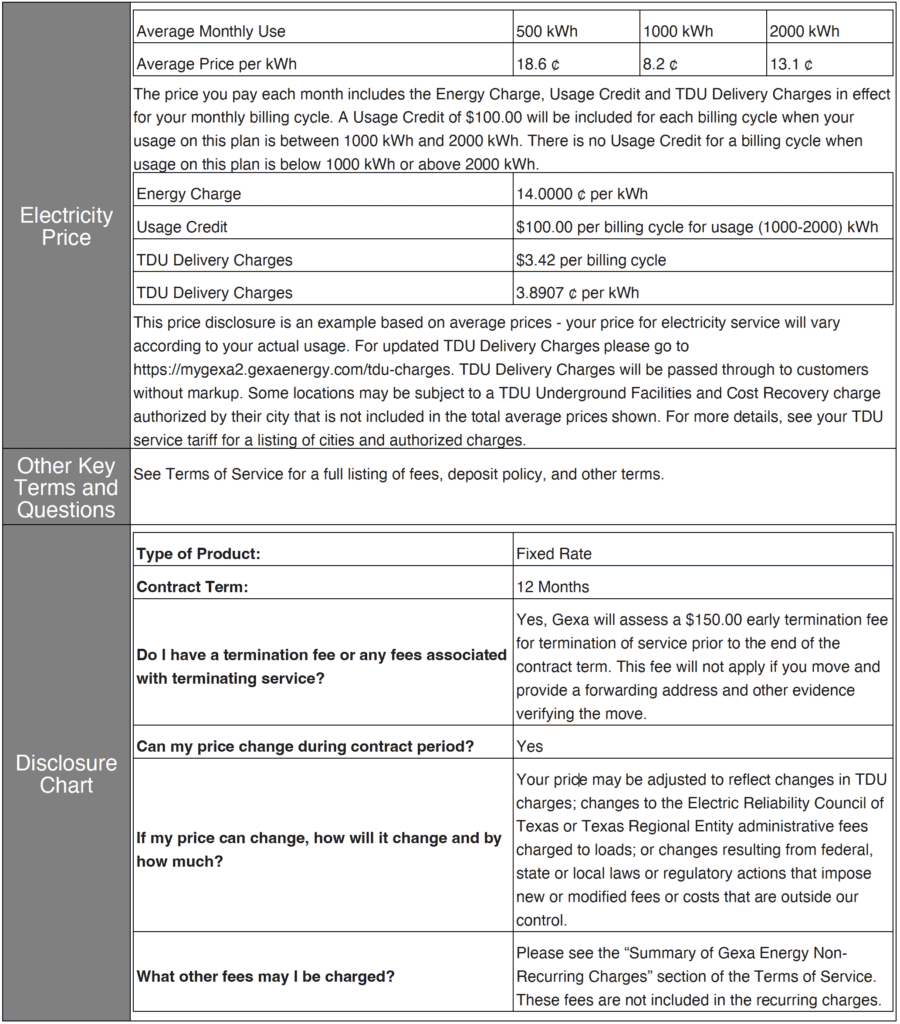
Sample Electricity Facts Label

Average price per kWh: The first thing you’ll notice on an EFL is a chart showing the average price of electricity depending on the average monthly usage in kilowatt-hours (kWh). 

It displays the average price per kWh charged if you use 500, 1000, or 2000 kWh per month.

Remember that this is only an example of what your payments may look like if you utilized those EXACT amounts of energy.

Base charge: The base charge is a cost that some companies will charge in addition to your monthly consumption.

Most plans have a base charge of five to ten dollars, but you should be wary of plans with higher base charges.

Energy charge: The energy charge is the rate at which your energy provider bills you for your electricity usage. 

It does not account for your usage levels and is the baseline for what you would be charged for each kWh of electricity you use.

Bill and usage credits: Bill or usage credits are also included in the pricing part of EFLs.

These look like a discount on your bill when you use a certain amount of electricity.

TDU delivery charges: The last price section you should look at is the Transmission and Distribution Utility (TDU) charges. 

These tell you any additional charges your utility company will add to your bill. TDU pricing in Texas is regulated and can only be altered twice a year.

Product disclosure: The disclosure part informs you of the type of energy plan you are enrolling in.

A fixed-rate plan maintains the same rate for your energy usage throughout the contract.

A variable-rate plan means that your supplier can adjust your pricing each month.

Contract term: The contract term tells you how long your electricity contract will last.

If you’re new to comparing Texas power and moving into a rental or an apartment, you don’t have to match your electricity contract with your lease.

Termination fee: If you want to cancel your service before the end of your contract period, you may be charged a termination fee.

Some companies will charge a flat fee, while others will charge based on the time left in your contract.

Price Changes: This indicates whether or not your provider can adjust the monthly fee you pay. 

These adjustments typically reflect changes in TDU rates or administrative costs levied by the Electric Reliability Council of Texas (ERCOT).

Pre-payment or advance payment: This tells you if your plan allows for prepayment or payment in advance.

Renewable content disclosure: The final section tells you if renewable sources generate your electricity.

Getting in touch: The final portion of an EFL contains all the contact information for the service provider in charge of that plan.

The ComparePower Advantage

At ComparePower, we take the guesswork out of comparing electricity plans.

Our user-friendly platform allows you to filter and sort plans based on your specific needs.

Whether you’re looking for a plan with no base charge, a plan with 100% renewable energy, or a plan with a specific contract length, we’ve got you covered.

The Bottom Line

Understanding your EFL is the first step to making informed energy choices.

With ComparePower, you have a trusted partner to guide you through the process.

So why wait? Start comparing electricity plans today and take control of your energy costs.

Ready to find your best energy plan and rate?

EFL FAQs

What is an Electricity Facts Label

EFL - Electricity Facts Label

The Electricity Facts Label (EFL) is a legal disclosure mandated by the Public Utility Commission of Texas (PUCT) that must be included with all energy plans. Amongst other factors, the EFL displays the average price per kWh charged if you use 500, 1,000, or 2,000 kWh per month.

Where can I find the Electricity Facts Label?

The Electricity Facts Label comes with every energy plan in Texas. On ComparePower, you can view the plan details for any plan you choose in our marketplace. Your energy provider can also send you a copy of your current EFL upon request.

What is the cost of electricity outside of the advertised 500, 1000, or 2000 kWh in Texas?

The Electricity Facts Label only discloses your price for 500, 1000, or 2000 kWh. To get the price for any other usage value, visit ComparePower.com – We fix the EFL in Texas by allowing you to shop energy plans for any usage or with your home’s specific annual usage profile. Fully transparent electricity shopping is available.

ComparePower 57500 5-Star Ratings Reviews

Any product or company names, marks, or logos shown on this page are the property of their respective owners. Compare Power is an unaffiliated, independent marketplace. Get unbiased, accurate information backed by our commitment to editorial integrity.

Are you tired of being surprised by your electricity bill every month?

Do you wish you could understand what all those charges mean? You’re not alone, and we’re here to help.

In this guide, we’ll explain how to read your electricity bill, the energy and utility charges, and more.

By the end, you’ll have a clear understanding of your electricity bill and be able to make informed decisions about your energy consumption.

TL;DR: Your bill is broken down into energy and Transmission and Distribution Utility (TDU) charges. Check for plan, usage, and TDU fee changes if you’re stuck with a surprisingly high bill.

Unraveling Bill Mysteries

Your electricity bill can be confusing, especially if it’s higher than expected.

Here’s how to read your electric bill and find out what’s causing those spikes:

  • Average kWh: Compare your usage to previous months to identify seasonal changes.
  • Energy Charge: Understand how rates can change based on your usage.
  • TDU Charge: Check for regulatory changes that might affect your bill.
  • Plan Changes: Look for unexpected changes in your plan that might increase costs.

How to Read Your Electricity Bill

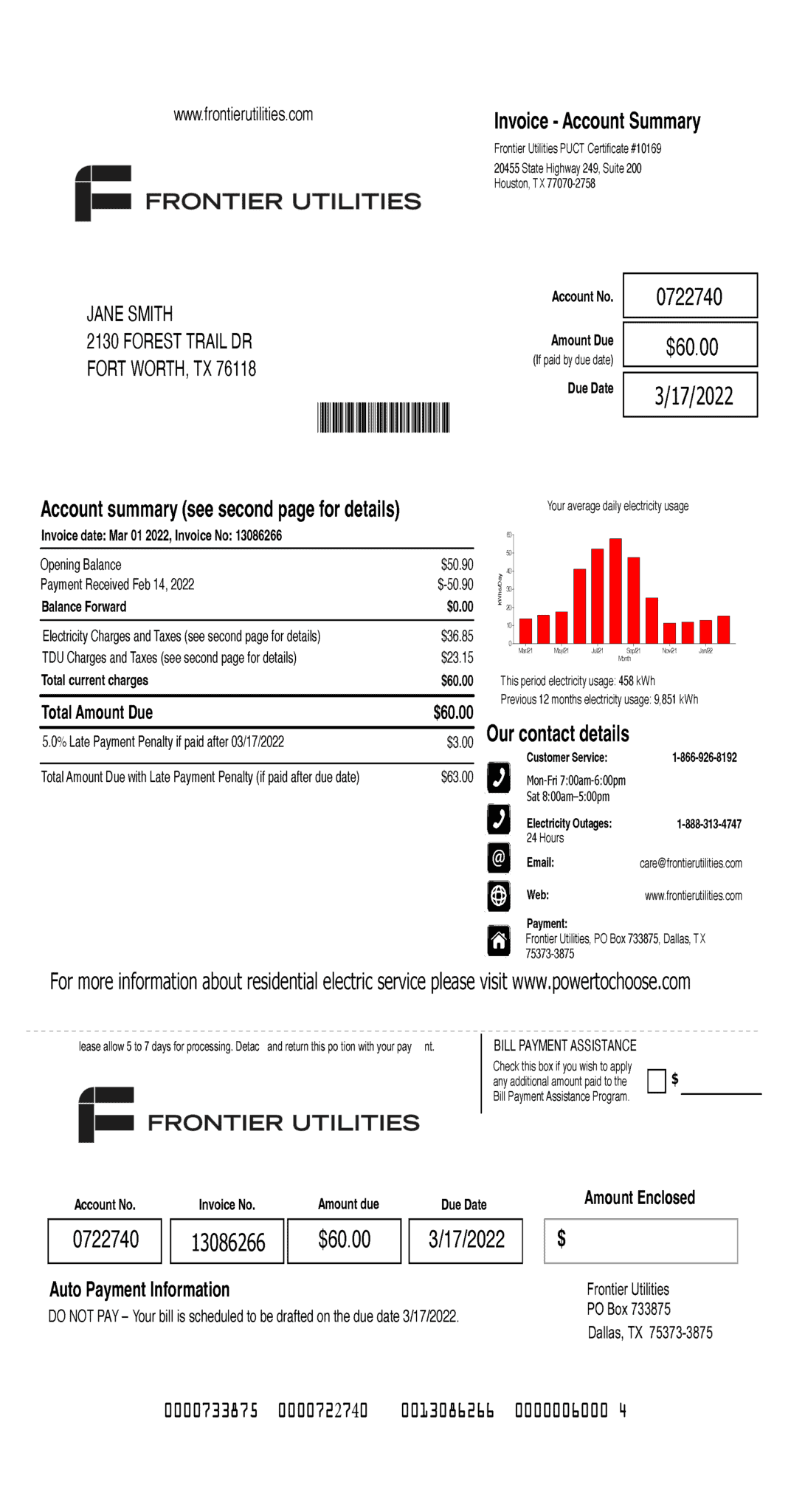
Your electricity bill is broken down into five main sections:

  1. Account Information: Key details like your account number and ESI ID.
  2. Bill Summary: An overview of current charges, including energy cost, supply fees, and taxes.
  3. Energy Consumption: A comparison of current and previous month’s usage in kilowatt-hours (kWh).
  4. Charges Breakdown: Detailed information on delivery and energy charges.
  5. Electricity FAQs: Common questions about electricity billing in Texas.

Sample Electricity Bill

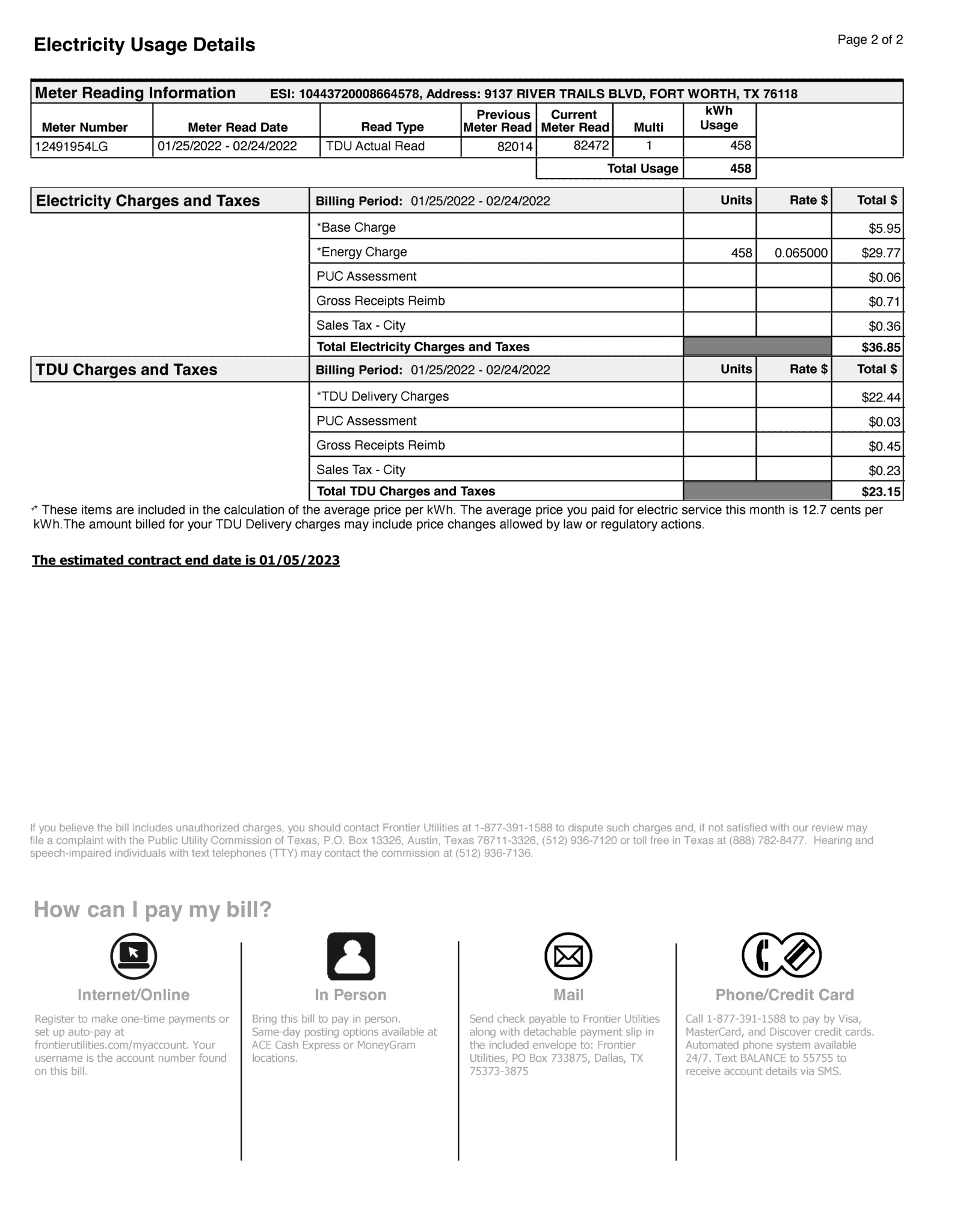
How to read electric bill Page 1
Front page – sample electricity bill
how to read electricity bill
Back page – sample electricity bill

ComparePower: Your Electricity Solution

  • All-Inclusive Pricing: Get accurate pricing that includes all charges you’ll see on your bill.
  • Easy Comparison: Compare rates and save money on your next power bill.
  • Energy-Saving Options: Learn how to avoid high electricity bills and find the best electricity rate per kWh.

Addressing Your Concerns

  • Worried about high bills? ComparePower helps you find inconsistencies and avoid overcharges.
  • Confused about charges? We provide a clear breakdown of utility charges on your electric bill.
  • Looking for a better plan? ComparePower helps you find the best energy-saving plans.

Don’t Miss Out

Without ComparePower, you might end up paying more than you need to.

You could miss out on understanding your electricity bill, leading to unexpected costs and less control over your energy consumption.

Take Action Now

Understanding your electric bill in Texas doesn’t have to be a daunting task.

From electric bill breakdowns to energy-saving options, we’re here to guide you every step of the way.

Choose ComparePower today and take the confusion out of your electricity bill. Your path to understanding starts here.

Electricity Bill FAQs

How is electricity billed in Texas?

In Texas, electricity consumers are billed by their electricity providers. Customers are charged for both the electricity used (energy charge) and the electricity (utility charge) delivery.

How do I read my electric bill?

You need to check the total usage and then the breakdown of the costs being charged. We’ll show you how to calculate the prices you paid and verify if they’re correct.

Is the bill provided by the utility or provider?

In deregulated areas of Texas, the bill for your energy usage is provided by the energy company you have chosen.

Texas has a deregulated energy market, which means you have the power to choose your energy supplier based on your preferences and budget.

The utility company in Texas is responsible for the physical delivery of electricity to your home or business via wires and poles. Utility charges are passed through on your energy bill.

Utility charges cover the cost of delivering electricity or gas to your home or business and maintaining the energy infrastructure.

On your bill, you will typically see utility charges itemized separately from the energy supply charges.