



Any product or company names, marks, or logos shown on this page are the property of their respective owners. ComparePower is an unaffiliated, independent marketplace. Get unbiased, accurate information backed by our commitment to editorial integrity.
Business Electricity Rates
Compare rates from 31+ Texas electricity providers and find the right energy plan for your business in minutes.
Table of Contents
Save on Business Electricity
Whether shopping for your small business or large commercial facility, access to competitive electric rates is easier than ever.
Get exclusive rates from energy companies that are unavailable online and get assistance with complex procurement projects, industrial installation design, and rebate opportunities.
Select the option that fits your needs ⤵️
Compare Energy Plans & Rates Instantly Online
Find and compare electricity rates from 31+ energy providers and enroll online instantly.
- Ideal for smaller businesses with monthly energy bills of less than $1,000.
- Instantly compare rates from multiple providers.
- Enroll your business online in minutes.
Get Custom Rate Quotes & Procurement Analysis
Talk to a business energy advisor if you have a large energy bill, need custom pricing or procurement expertise, have several sites, or want to learn more about energy efficiency programs and rebates. Contact us today to learn how we can provide tailored energy solutions for your business.
- Expect to spend more than $1000 per month?
- Speak with one of our energy experts in real time.
- Get a custom analysis of your company’s energy options.
Small Business Electricity
Over 2.2 million small businesses call Texas home, making it a thriving state for small to mid-sized companies.
Regarding small businesses, Texas ranks among the top 5 states in the continental U.S., with business-friendly regulations, smart spending, and low taxes.
Since 2002, Texas business owners have had the power to choose their electricity provider.
Several retail electricity providers compete to meet the electricity needs of your small business.
From Houston to Dallas-Fort Worth, Corpus Christi, and all over the Lone Star state, we help you compare the rates of dozens of Texas business energy suppliers to save time and money.
By inviting multiple energy companies to compete for your business, ComparePower bridges the gap between you and the energy companies.
Let us find you a competitive electricity rate and take control of your energy budget with fixed-rate pricing.
You save when energy companies compete for your business.
Commercial Electricity Rates
In addition to some of the nation’s largest publicly traded companies, such as AT&T, ExxonMobil, and Dell, Texas is also home to some of its largest privately held companies, including H-E-B, Neiman Marcus Group, and Hunt Oil.
Energy deregulation and the availability of electric choice in Texas allow businesses to reduce energy-related costs by selecting a commercial electricity rate that meets their needs and budget.
Find your large business’s best commercial electricity rates in Texas, and start saving today.
Call 469-813-8854 or request your custom quote today.
Switching Business Electricity
Every time your contract is about to expire, you should shop the market for a lower rate.
Your electricity rate may increase once your existing contract expires.
If you fail to act, you’ll be stuck with a variable month-to-month rate significantly higher than you enrolled in.
Make sure you compare rates from competing electricity providers before renewing your contract.
You can save hundreds or thousands of dollars annually by switching to a cheaper electricity provider.
We make switching easy:
- There is no need to contact your current company to cancel (no break-up call).
- No one comes to your business to turn the power on or off.
- Your electricity service reliability is not disrupted.
- It only takes a few minutes to switch.
- You could realize significant savings.
If you switch electricity providers, your newly chosen company will handle everything, including switching services from your previous provider.
Switching electricity providers in Texas won’t disrupt your service because it is all delivered by your utility; therefore, the reliability of your electricity service will not be affected.
Most business electricity contracts do not charge early termination fees if you switch within 14 days of the contract expiration date.
You are protected by Texas law here. Check your contract for specific details around your contract expiration date.
If you are currently under contract, determine how many months are left.
Most providers allow you to lock in pricing for a future start date regardless of when your contract ends.
Learn how to start or switch business electricity and save ⤵️

How to Switch Business Electricity in Texas

How to Start Business Electricity Service in Texas
Why Your ZIP Code Changes What You Pay
Texas business electricity costs vary wildly by zip code. Houston and Dallas sit less than 250 miles apart, yet a 500 kW operation pays 2.5+ cents more per kWh in one city versus the other. Same market, same weather, same grid. The difference isn’t your supplier. It’s your utility infrastructure provider (your TDU), and you’re stuck with whichever one serves your address.
Did you know?
- Houston and Dallas sit 250 miles apart yet a 500 kW business can pay 2.5 cents more per kWh in one city versus the other because of TDU territory differences.
- San Antonio and Austin businesses served by municipal utilities cannot choose their electricity provider, eliminating the 15 to 30 percent savings available in deregulated cities.
- Multi-location businesses operating across TDU territories can aggregate consumption for volume discounts that single-location accounts cannot access.
Here’s what most Texas businesses don’t know: commercial electricity rates average 8.26 ¢/kWh cents per kWh statewide, but that’s a deceptive headline. The real range is 5.25 to 11+ cents depending on which city you’re in and which TDU territory that city falls under. Your competitors across town might be locking in rates 15-30% cheaper without doing anything different. Just better geography.
This guide benchmarks commercial electricity costs across Texas’s largest metros, explains why rates differ so dramatically by TDU territory, and shows you exactly how much your location is costing you relative to the state baseline. If you’re a multi-location operator, this matters even more. You probably have locations in high-cost and low-cost territories simultaneously without realizing it.
The core mechanics: every Texas electricity bill has two parts. Energy (what you consume) gets priced on the wholesale market where suppliers compete. Delivery (infrastructure: poles, wires, transformers, meters) is set by your TDU and regulated by the Public Utility Commission of Texas (PUCT). You pay both. The TDU is non-negotiable. The energy component is where deregulation gives you choice, and where timing and supplier selection can save you 10-25% annually.
This breakdown covers the 6 largest Texas metros by commercial rate patterns, explains the TDU mechanics, breaks down demand charges (the hidden cost most businesses miss), and gives you a decision framework for contract timing and multi-location optimization.
Commercial Electricity Rates Across Texas
Your electricity bill breaks into two components with separate cost drivers. Energy-only rates are where deregulated competition happens. Delivery charges are infrastructure costs your TDU maintains, and they’re identical for every supplier in that territory. There’s no negotiating with your TDU. It’s regulated by PUCT. You pay what the utility files.
Texas has six major TDU territories, each with different infrastructure maturity, demand growth trajectories, and regulatory environments. Here’s the breakdown by delivery cost.
Oncor Electric Delivery serves Dallas, Fort Worth, Central Texas, and surrounding areas. It’s the largest TDU by customer count (10 million people) and has the lowest delivery charges in Texas: 4.1867 cents per kWh flat, plus a monthly customer charge of $3.42. Oncor’s scale and mature infrastructure mean per-unit delivery costs that don’t exist elsewhere in the state.
CenterPoint Energy serves Houston, Galveston, Conroe, and Southeast Texas. It’s the most expensive TDU: 6.001 cents per kWh delivery, plus monthly fees. CenterPoint is upgrading for massive demand growth (petrochemical loads, data centers, Tesla factories). Those infrastructure investments get passed to customers immediately.
TNMP (Texas-New Mexico Power) fragments across North Texas and the Panhandle with rates between 5.2 and 5.8 cents per kWh depending on service area. AEP Texas splits into AEP Central (serving Corpus Christi, McAllen, Harlingen, central areas) at roughly 4.8 cents, and AEP North (Panhandle, Abilene) at around 4.5 cents. Lubbock Power & Light (LP&L) just deregulated in January 2024 with delivery charges around 5.0-5.3 cents.
Here’s the critical distinction: some of these territories are deregulated (you can shop suppliers), and some are not.
Deregulated areas (ERCOT control) mean 100+ retail providers compete for your business. You can lock rates 12-60 months. You can switch providers every time your contract expires. You have leverage. This applies to most of Texas outside a few cities: Houston (CenterPoint), Dallas (Oncor), most suburbs, most rural areas, and Lubbock (as of Jan 2024).
Non-deregulated territories (municipal utilities outside ERCOT) mean no choice. San Antonio (CPS Energy) is fully municipal. Austin (Austin Energy) is fully municipal. El Paso (El Paso Electric) is separate. These cities set rates through city council approval. You get one rate. No negotiation. No switching. No lock-in strategy because there’s no locking in; the rate just is.
The math is stark. Oncor territory (Dallas): baseline 4.1867 cents delivery. CenterPoint territory (Houston): 6.001 cents delivery. That’s 1.8 cents per kWh structural cost difference before you’ve even chosen a supplier. For a 500 kW operation pulling 200,000 kWh per month, that delivery difference alone is $3,600 per month, or $43,200 annually.
But here’s where it gets interesting. Houston’s deregulated market drives energy-only rates down to compensate. Dallas has Oncor’s cheap delivery but faces slightly higher wholesale energy costs. Net result: Houston and Dallas are roughly comparable on total all-in rates despite very different delivery structures. San Antonio (municipal, no deregulation) has no such competition. Rates are simply higher across the board with no mechanism to fix it except efficiency improvements.
Demand charges (measured as 4CP, your peak kW usage during summer peak hours) represent 30-70% of commercial bills depending on your load profile. That’s the hidden cost most businesses miss. A 500 kW facility with flat usage might face demand charges of $1,500-2,500 per month on top of energy. Peak-heavy operations can face $3,000-5,000. The wholesale component might be half that cost. Demand management and off-peak shopping become critical for anything above 200 kW.
Houston Commercial Electricity Rates
Houston suppliers advertise some of the lowest energy-only rates in America. The numbers look incredible: 5.25 cents per kWh. Then you add CenterPoint’s delivery charges (6.001 cents per kWh), demand charges (30-50% of bill), and ancillary fees. Suddenly you’re at 11-13 cents all-in. The market math is real: cheap energy, expensive delivery.
CenterPoint is the most expensive TDU in Texas because it maintains the most complex grid. Houston’s industrial load is unlike anywhere else: petrochemical refineries with massive year-round demand, port operations, data center clustering, heavy manufacturing. That infrastructure complexity translates directly to higher per-unit maintenance costs. It’s structural, not negotiable. Every Houston business pays it regardless of supplier choice.
Here’s the cost breakdown. Energy-only rates from retail providers in Houston range from a floor of 5.25 cents to an average around 7.72 cents before any delivery or demand charges. CenterPoint’s flat delivery add-on is 6.001 cents per kWh. For a typical 500 kW operation using 200,000 kWh per month, energy costs roughly $1,045-1,544, delivery costs $1,200, and 4CP demand charges (assuming a 600 kW peak during summer months) run another $500-1,000 per month depending on how the demand window overlaps with the facility’s actual load profile. All-in monthly cost: $2,745-3,744, or roughly 11-13 cents per kWh total.
Summer peaks matter significantly. ERCOT demand gets highest during afternoon and early-evening hours (2-8 PM) June through September. During those 4-month windows, wholesale prices spike to 15-20 cents per kWh on hot days, driving fixed-rate suppliers to lock higher rates when you renew during summer months. Off-peak shopping (March-May, September-November) yields 8-12% discounts.
Houston’s competitive advantage comes from pure supplier volume. 40-50 providers compete for Houston accounts, driving margins down. You can lock rates 12-60 months and flip providers every renewal if a competitor undercuts. Multi-location chains get 3-5% portfolio discounts for consolidating Houston accounts plus other service territories under one contract.
Demand charge management is your biggest lever. Installing load controllers, shifting non-critical processes to off-peak hours, or adding on-site generation reduces your 4CP measurement. A facility that cuts peak demand by 15% might reduce annual demand charges by $8,000-15,000. For energy-intensive operations, this becomes a competitive advantage.
Houston is best suited for businesses with stable, predictable baseload. 24/7 operations (data centers, manufacturing, warehouses) can lock in 5.8-6.5 cent energy-only rates and commit 24-36 months. Facilities with peak-hour flexibility should shop off-season (March-May) and lock shorter terms (12-18 months) to renegotiate when demand dips.
Dallas – Fort Worth Commercial Electricity Rates
Dallas and Fort Worth have the cheapest commercial electricity in Texas. Not because suppliers cut deeper. Because Oncor’s delivery charges are the lowest in the state. Every major provider operating in DFW territory passes that cost advantage to customers, creating structural pricing gains that stack across all suppliers and all contract types.
Oncor’s 4.1867 cents per kWh delivery is nearly 2 cents cheaper than CenterPoint’s 6 cents. Oncor serves 10 million people across the largest geographic footprint in Texas, with mature infrastructure and relatively predictable demand growth. That scale advantage is real and sustainable. A DFW business paying 9.2 cents all-in versus a Houston business paying 12.5 cents isn’t a supplier difference. It’s a geography win.
Here’s the DFW cost structure. Oncor delivery: flat 4.1867 cents per kWh. Retail energy-only rates from providers average 4.8-5.1 cents. Combined energy plus delivery runs 8.9-9.2 cents all-in before demand charges. For a 500 kW operation at 200,000 kWh per month, that’s roughly $1,760-1,840 in energy plus delivery costs, plus 4CP demand charges (35-55% of the bill, another $800-1,600 depending on load profile). Monthly total: roughly $2,560-3,440, or 8.9-9.2 cents per kWh all-in.
Seasonal variation matters in DFW. February-March and September-October see demand dips as cooling and heating loads drop temporarily. Off-peak shopping during those months yields 0.3-0.5 cent rate discounts versus locking during summer peaks. For a business on a standard quarterly contract renewal cycle, timing renewal completion for late February or late September nets measurable savings.
The DFW market is hyper-competitive. 50+ providers serve the Oncor territory. If you’ve been with your current supplier for 24+ months without shopping, odds are high you’re paying 0.3-0.5 cents more per kWh than available market rates. Multi-location chains with DFW operations should aggregate all DFW locations under one portfolio contract to maximize volume discounts (3-5% typical for aggregation).
Contract length strategy is important here. 12-month contracts offer flexibility as market conditions shift, but rates reset annually and risk rising 0.5-1 cent if demand spikes unexpectedly. 24-36 month contracts typically cost 0.2-0.5 cent more per kWh but lock price certainty through 2027-2029 when grid stress is expected to peak due to data center growth and infrastructure lags. With 9.6% ERCOT demand growth expected in 2026, longer-term locks at slight premiums often pay off.
DFW is the expansion market for multi-location Texas businesses. Cheapest rates, most suppliers, most mature market. If you’re choosing between DFW and other Texas locations for capacity growth, DFW’s electricity cost advantage alone justifies consideration.
San Antonio Commercial Electricity
San Antonio businesses don’t have suppliers. They have CPS Energy, a municipal utility outside ERCOT deregulation, with all-in rates fixed at approximately 10.5 cents per kWh. There’s no negotiating. No supplier shopping. No rate locking. No strategy other than accepting the rate and optimizing usage.
In February 2024, CPS Energy raised rates 4.25%. Additional increases are planned for 2025-2026. San Antonio businesses face structural cost inflation without a negotiation lever. The utility sets the rate. City council approves it. You pay it or relocate.
San Antonio all-in rates (10.5 cents) sit 1.3-1.6 cents higher than Dallas (8.9 cents) and 1.5-2 cents higher than Houston deregulated alternatives (despite Houston’s expensive delivery). That difference compounds. A multi-location chain with 10 San Antonio locations at 500 kW each, pulling 1 million kWh per month, pays roughly $105,000 monthly versus $89,000-92,000 in Dallas locations. Annual cost difference: $156,000-192,000.
CPS Energy charges break down roughly: energy portion ~6.5-7 cents, delivery portion ~2.5 cents, demand charges ~1.5 cents, and service fees 0.15-0.25 cents, all combined into a single published rate. You get no visibility into which component is which. You get no ability to optimize one component separately.
San Antonio’s non-deregulation comes from municipal ownership and a different historical grid structure. The utility isn’t subject to ERCOT market competition or PUCT-style regulatory pressure. It’s governed by city council, which approves annual budgets and rate increases based on utility operational needs. Efficiency and demand reduction are your only levers.
Summer cooling demand spikes 30-40% June-August as air conditioning loads peak. Demand charges rise proportionally. Implementing demand management (load shifting, insulation improvements, cool roofing, HVAC efficiency upgrades) reduces peak demand by 10-15%, dropping annual electricity costs by 8-12% for facilities with significant cooling loads. For a warehouse at 10.5 cents, cutting demand by 15% might save $12,000-18,000 annually on a $100,000+ yearly bill.
Solar and on-site generation become higher-ROI investments in San Antonio than in deregulated markets. Localized production reduces demand from CPS Energy’s grid, cutting both energy and demand charges. A 50 kW solar array at 10.5 cents baseline, offset by annual demand reduction, pays back in 5-6 years in San Antonio versus 6-7 years in Dallas (where rates are lower but solar incentives are identical).
Multi-location chains should seriously evaluate relocation math. Consolidating from San Antonio headquarters to Dallas costs money (real estate, retraining, operational disruption) but saves $150,000+ annually for large operations. Payback timeline on relocation costs: 2-3 years for >$1 MW operations. For <200 kW operations, the cost-shift is manageable and relocation doesn’t make economic sense.
San Antonio businesses should budget 10.5+ cents through 2027 and assume further increases. The utility is in infrastructure investment mode, and rate hikes are structural, not cyclical.
Austin Commercial Electricity
Austin Energy customers pay the highest commercial rates in Texas. All-in rates sit at 11+ cents per kWh, and monthly service fees just jumped to $75 in 2026 (up from $65 in 2024). For a 500 kW facility, that’s an extra $900 annually in flat fees before the first kWh is consumed.
Austin Energy is a municipal utility outside ERCOT deregulation, governed by Austin City Council and the Austin Energy Resource Management Commission. Rates are set through public vote. There’s no supplier shopping. No market competition. No leverage except efficiency and load reduction.
Austin’s costs break down to roughly: energy 6.5-7.5 cents, delivery 2-2.5 cents, demand charges 1-1.5 cents, plus service fee components. The total compresses into Austin’s published rate structure, which you can’t change or avoid. A 500 kW business at 200,000 kWh per month pays roughly $2,200 in energy and delivery, $300-600 in demand charges, and $75 in monthly service fees. Total: $2,575-2,875 monthly, or roughly 11-12 cents per kWh before any one-time charges.
Why is Austin the most expensive? Austin Energy has a 100% carbon-neutral by 2035 mandate, driving renewable infrastructure investment that exceeds cost-efficient timelines. City-owned utilities can’t shift costs to wholesale markets the way deregulated providers can. All grid upgrade costs get passed directly to customer rates.
Austin’s fast-growing demand (Tesla Gigafactory opening, major data center clusters, tech headquarters migration from San Francisco) is straining infrastructure faster than upgrades can deploy. Demand growth outpaces supply, driving rate increases faster than state average.
Austin’s 2026 service fee increase signals the trajectory. Every $10 annual increase in flat fees costs a 500 kW business an extra $900. These flat-fee hikes are structural responses to infrastructure investment timelines, and they’re scheduled to continue through 2028.
For multi-location chains, Austin represents a cost penalty. A tech company with Austin and Dallas locations pays 11+ cents in Austin and 8.9-9.2 cents in Dallas. The differential justifies operational optimization: shift customer service, back-office, non-customer-facing functions to Dallas. Keep customer-facing operations (retail, support centers) in Austin if required by market presence.
Austin businesses should focus on efficiency: LED retrofits, HVAC optimization, demand management during peak hours. These improvements yield faster ROI in Austin (11+ cent baseline) than in cheaper markets. A lighting retrofit that saves 15% on a $100,000 annual bill saves $15,000 annually, paying back within 3-4 years even if retrofit costs run $30,000-40,000.
Renewable energy premiums aren’t available in Austin (Austin Energy controls supply). Solar and wind PPAs do exist, but they’re contracted through the utility directly, not through retail suppliers. This makes on-site generation the only carbon-neutral path for cost-conscious Austin businesses.
Budget Austin operations at 11+ cents through 2027. Rate increases of 3-4% annually are structural, not cyclical.
Lubbock Commercial Electricity
Lubbock deregulated on January 1, 2024. For 50+ years before that, Lubbock Power & Light (LP&L) was a monopoly utility. Businesses had zero choice. Now, 15-20+ suppliers compete for Lubbock customers, and rates are dropping.
Early data shows Lubbock’s post-deregulation rates 8-12% below pre-January 2024 monopoly pricing. A business that locked in with an incumbent provider early 2024 might see an all-in rate of 8.5-9.5 cents compared to the old 9.5-10.5 cent monopoly baseline. That 1-cent drop is real and ongoing.
Lubbock’s deregulation is still young (less than 2 years). Supplier market penetration is low. About 10-15% of Lubbock businesses have switched suppliers; 85% are still on LP&L’s default rates. Massive savings opportunity exists for businesses that haven’t yet shopped.
Here’s why Lubbock deregulation happened and what it means. LP&L serves Lubbock and surrounding Texas Panhandle rural areas. The Public Utility Commission of Texas mandated deregulation starting in 2023, effective January 1, 2024. LP&L now operates as a pure transmission and distribution utility (like Oncor or CenterPoint). Retail providers (Gexa Energy, TXU, Constellation, smaller competitors) now sell energy to Lubbock customers.
LP&L’s delivery charges are approximately 5.0-5.3 cents per kWh (subject to adjustment March 1 and September 1 each year). Retail energy rates from deregulated providers currently range 3.2-4.0 cents per kWh for commercial customers. All-in rates (delivery plus energy) run 8.2-9.3 cents. That’s competitive with Dallas (9.2 cents) and substantially cheaper than Houston (11-13 cents), San Antonio (10.5 cents), or Austin (11+ cents).
Lubbock’s competitive advantage is agricultural and manufacturing-heavy demand. The region’s constant irrigation loads, agricultural processing facilities, and manufacturing all have flat or predictable demand profiles. These businesses can lock 24-36 month rates at 0.4-0.7 cent discounts to short-term.
Renewable energy is a Lubbock strength. The Texas Panhandle has exceptional wind resources. Renewable energy premiums in Lubbock are the lowest in Texas (0.2-0.3 cents above conventional rates) because local wind farms can directly supply local load. An agribusiness pursuing renewable compliance can pay only 8.4-9.0 cents for 100% wind-backed energy in Lubbock, versus 8.8-9.6 cents in Dallas or 9.5-11+ cents elsewhere.
Green Mountain Energy, Chariot Energy, and Gexa Energy all serve Lubbock with renewable options. The competitive landscape is still settling post-deregulation, but green energy cost parity with conventional is nearly achieved in Lubbock.
For Lubbock businesses that haven’t yet shopped: competitive RFP responses should arrive within 5-7 business days if you contact 3-5 providers with your historical usage data. Switching costs are minimal. The rate savings for a 300 kW operation might run $8,000-15,000 annually. Analysis costs <$500. ROI: 2-4 months.
Lubbock’s deregulation is recent enough that market suppression won’t last. Rates will likely normalize toward Dallas levels (9+ cents all-in) within 12-18 months as supplier competition matures and margin compression kicks in. Early adopters locking 24-36 month rates now get ahead of that.
Contract Length, Demand Charges, and Multi-Location
Most Texas business owners miss 8-15% annual savings by ignoring contract timing, demand charges, and portfolio leverage. These three levers operate independently. Together, they compound into massive cost differences between optimized and default operations.
Your electricity bill breaks down roughly: 25-40% energy charges, 30-70% demand charges, 5-15% ancillary fees and taxes. Businesses typically focus only on the energy component and miss demand charges entirely. This is the primary reason sophisticated operators outperform default-rate businesses by 15-25% annually.
4CP demand charges are the hidden cost. 4CP stands for “4 Coincident Peak.” It measures your facility’s average kW demand during the four highest ERCOT system peak hours of June, July, August, and September combined. Your supplier charges you that peak kW multiplied by 4 months, applied across 12 months of billing. So a 600 kW peak translates to a $600/month demand charge for the full year, even if you only hit that peak 4 times.
Here’s why it matters. A Houston operation with 30 kW baseline demand but a 600 kW peak during summer cooling hours faces roughly $600/month demand charges (calculated as 600 kW × 4 month factor). That’s $7,200 annually from a single 4-month peak measurement. For a facility where energy costs $1,200/month, demand charges just doubled the annual bill. Most business owners have no idea.
The leverage is load management. Shifting non-critical processes to off-peak hours (9 PM-7 AM), installing load controllers, adding on-site generation, or implementing scheduled maintenance outside peak season can reduce your 4CP measurement by 20-30%. A 15% reduction saves $1,000+ monthly or $12,000+ annually for large facilities. The capital investment in controls or batteries pays back in 2-4 years. But almost nobody does it because they don’t understand the cost structure.
Contract timing compounds these gains. When you shop determines your rate. March-May and September-November are off-peak seasons when demand is lowest. Suppliers cut margins because they’re fighting for market share. Off-peak shopping yields 0.3-0.5 cent per kWh discounts versus summer peaks. For a 500 kW facility, that’s $6,000-12,000 annual savings just from timing.
Contract length strategy depends on your risk tolerance and 2026-2027 market outlook. 12-month contracts offer flexibility. Rates reset annually. If ERCOT demand growth slows or supply additions come online faster than expected, you renegotiate lower. Downside: if demand exceeds supply (currently projected for 2027-2028), rates spike and you’re locked into renewal at that elevated market.
24-month contracts cost 0.2-0.4 cents more per kWh but lock price certainty. 36-month contracts cost 0.2-0.5 cents more but cover you through 2029. With 9.6% ERCOT demand growth projected for 2026 and data center clustering driving demand above historical norms, longer-term locks at slight premiums often save money by avoiding future spikes. For a 500 kW operation, a 0.3 cent premium on a 36-month lock costs an extra $36,000 but saves $50,000-100,000 if rates spike 1-2 cents in 2027-2028.
Multi-location portfolio contracts are where sophisticated operators unlock 5-8% additional savings. A 10-location retail chain at 2 MW total across Houston (CenterPoint), Dallas (Oncor), and San Antonio (CPS Energy) can’t consolidate all locations under one rate (TDU delivery varies by territory). But major providers (TXU, Constellation, Direct Energy) serve multiple territories and can offer portfolio energy rates unified across locations, with TDU delivery charges applied separately by location. The portfolio energy rate might be 4.6 cents (negotiated down from 4.9 cents due to volume), while each location still pays its TDU delivery.
The math: a 10-location chain at 500 kW each (5 MW total) with separate supplier contracts at 4.9 cent energy rates pays roughly $294,000 monthly for energy alone (5 MW × 4.9 cents × 30 days). A portfolio contract at 4.6 cents drops that to $276,000. Annual difference: $216,000. That’s real money. The analysis and contract renegotiation cost $5,000-10,000. ROI: 2-4 weeks.
For multi-location chains, the optimal strategy: group locations by TDU territory first. Request separate portfolio quotes from your top 3 providers for each TDU territory. Compare the portfolio rates against standalone quotes. If portfolio bundling saves 3%+ versus standalone, aggregate. If gains are marginal (<2%), stay with standalone and maximize supplier competition within each territory separately.
Demand charge management for multi-location chains: consolidate peak demand profiles. A retail chain with 10 locations hitting peak demand in afternoon hours (all locations have same A/C peaks) faces identical 4CP measurements across all locations. But a chain with mixed operations (office peaks at 2 PM, warehouse peaks at 11 PM) can load-shift non-critical processes across locations to flatten portfolio peak. This requires real-time consumption monitoring and operational flexibility but can cut portfolio demand 10-20%. Annual savings for a 2 MW portfolio: $50,000-100,000.
The Bottom Line
If you’re expanding in Texas, Dallas wins on electricity costs. Oncor’s 4.1867 cent delivery is the structural advantage. If you’re in Houston, accept the 6-cent delivery and compete on energy and demand management. If you’re in San Antonio or Austin, budget for 10.5-11+ cent monopoly rates and focus on efficiency as your only lever.
Here’s a quick budget framework per 500 kW operation at 200,000 kWh per month:
Dallas (Oncor territory): 8.9-9.2 cents all-in, roughly $8,500-11,000 monthly.
Houston (CenterPoint territory): 11-13 cents all-in for standard operations, $10,500-13,000 monthly (but 5.25-7.72 cent energy-only rates available for baseline, offset by expensive delivery and demand).
Lubbock (LP&L territory, newly deregulated): 8.5-9.5 cents all-in, $8,200-11,500 monthly.
San Antonio (CPS Energy, municipal): 10.5+ cents all-in, $10,000-12,500 monthly, non-negotiable.
Austin (Austin Energy, municipal): 11+ cents all-in, $10,500-13,000+ monthly, with rising service fees.
Here’s your decision framework:
If you’re choosing a new location for expansion: Dallas. Cheapest rates, most suppliers, most deregulation, highest maturity. Lubbock is competitive post-deregulation, but deregulation is recent and market pricing will normalize upward. San Antonio and Austin are 1.5-2 cents more expensive with zero negotiation levers.
If you’re already in Houston: Manage demand charges aggressively. Load shifting, peak shaving, and on-site generation can offset high delivery costs. Lock rates during off-peak shopping (March-May, September-November). For operations with <200 kW demand, Houston’s rates are manageable. For >500 kW, demand management becomes mission-critical.
If you’re multi-location across different territories: Aggregate demand across Houston and Dallas locations if possible. Oncor delivery is cheap; negotiate portfolio energy rates to compete with Houston on total cost. Use portfolio discounts (3-5% typical) to offset any higher energy rates Oncor territory carries versus Houston.
If you’re in a municipal utility territory (San Antonio, Austin): Budget for 10.5-11+ cent rates as baseline. Efficiency investments (solar, LED, HVAC, demand controls) are the only cost-control path. Analyze relocation ROI for >500 kW operations (payback often 2-3 years).
For contract timing: Lock rates during March-May or September-November when demand is lowest and supplier competition is highest. Avoid June-August summer locks; rates spike 0.5-1.5 cents due to peak demand. Start shopping 60-90 days before your current contract expires.
For contract length: 12-month contracts offer flexibility but reset annually at whatever market rate prevails. 24-36 month contracts cost 0.2-0.5 cents more per kWh but lock certainty. With 9.6% ERCOT demand growth and wholesale market tightness expected through 2028, longer-term locks at slight premiums often outperform short-term flexibility. The break-even point: if you believe rates will spike 0.5+ cents in year 2-3, longer terms pay off.
Action plan for the next 30 days:
1. Pull your last 12 months of electricity bills. Note your TDU (visible on the bill), monthly consumption (kWh), peak demand (kW), and current rate (¢/kWh). Compare your rate against the benchmarks in this guide for your city.
2. If you’re 0.5+ cents above the benchmark for your city and TDU territory, request RFP quotes from 3-5 suppliers. Include your historical data and specify all-in cost (energy + estimated delivery + estimated demand charges) not energy-only rates.
3. For multi-location operators: map all locations by TDU territory and contract end date. Request portfolio quotes from your top 2-3 providers that serve all your territories. Compare portfolio pricing against standalone quotes.
4. Determine contract timing: if your contract expires June-September, note that you’re in peak season. Plan your next renewal for February-April of the following year to capture off-peak pricing.
5. If demand charges exceed 40% of your bill, request a load analysis from your supplier or an energy consultant. Identify peak demand periods and calculate potential savings from 10-15% demand reduction.
Identify which TDU territory you’re in using your utility bill or comparepower.com. Dallas, Lubbock, and parts of Central Texas: Oncor, and you’re already in the cheapest market. Houston area: CenterPoint, and you should prioritize demand management. San Antonio: CPS Energy, budget monopoly rates. Austin: Austin Energy, budget monopoly rates with annual increases. Panhandle or rural North Texas: check TNMP or AEP territories on your bill. For additional guidance on service areas, visit our Texas TDU service areas resource.
Business Electricity FAQs
Every Texan deserves to make informed energy decisions.
Who has the cheapest business electricity rates in Texas?
There are over 60 energy providers in Texas. Finding the cheapest rates for your Texas business depends on various factors, including size, location, and energy needs. However, Texas businesses may find cheaper electricity rates by shopping for deals and comparing rates from different providers.
What is the average business electricity rate in Texas?
The average business electricity rate in Texas is 8.26 ¢/kWh, 39.0% less than the U.S. average.
How can I compare business electricity rates in Texas?
You can compare business electricity rates in Texas by:
1. Using online comparison tools like ComparePower
2. Contacting multiple providers directly for quotes
3. Working with an energy broker or consultant
What factors affect commercial electricity rates in Texas?
Several factors influence commercial electricity rates in Texas:
1. Market conditions and energy prices
2. Seasonal demand
3. Business size and energy consumption
4. Contract length and terms
5. Location within Texas
What are the cheapest commercial electricity providers in Texas?
The cheapest provider can vary depending on your specific needs. Some well-known providers in Texas include TXU Energy, Reliant Energy, and Direct Energy. However, it’s best to compare current rates as they change frequently.
How can Texas businesses lower their electricity rates?
Texas businesses can lower their electricity rates by:
1. Shopping around and comparing rates regularly
2. Negotiating contracts with providers
3. Implementing energy-efficient practices
4. Considering long-term contracts during periods of low rates
5. Participating in demand response programs
Are there fixed-rate commercial electricity plans in Texas?
Yes, many providers offer fixed-rate commercial electricity plans in Texas. These plans lock in your rate for the duration of your contract, providing price stability and protection against market fluctuations.
What should I look for in a business electricity contract in Texas?
When reviewing a business electricity contract in Texas, consider the following:
1. Contract length
2. Early termination fees
3. Usage minimums or maximums
4. Additional fees or charges
5. Any renewal terms
6. Green energy options
Compare Power is here to help you navigate these choices and find the best plan for your business needs.
What Is the difference between energy-only and all-in rates?
Energy-only rates quote just the wholesale component (typically 6.80 cents average across Texas before any TDU charges). All-in rates include energy plus TDU delivery charges (4-6 cents depending on territory) plus demand charges (30-70% of bill). Suppliers quote energy-only because it’s their component. Your total bill includes delivery. Always request all-in estimates when shopping so you’re comparing apples-to-apples.
Can I negotiate my TDU delivery charges?
No. TDU delivery charges are PUCT-regulated and applied identically to all retailers in that territory. Oncor’s 4.1867 cents applies to every Oncor customer regardless of which supplier you choose. You can’t negotiate this component. Your only option: locate operations in lower-delivery-charge territories (Oncor cheaper than CenterPoint). The energy-only component is what you negotiate with suppliers.
How much of my commercial electricity bill is from demand charges?
Demand charges typically represent 30-70% of commercial bills, depending on load profile. A facility with constant baseload (data center, wastewater treatment) might see 30-40% demand. A facility with sharp peak demand (retail with A/C, warehouse with heavy machinery) might see 60-70%. For a 500 kW operation with $100,000 annual bill, demand charges likely run $30,000-70,000 depending on usage shape.
Should I lock a 36-month contract now to protect against 2027 rate spikes?
That depends on your risk tolerance and financial flexibility. 36-month contracts cost 0.2-0.5 cents more per kWh but lock certainty through 2029. With 9.6% ERCOT demand growth and wholesale tightness projected, this insurance often pays off. For a 500 kW operation, a 0.3 cent premium costs $36,000 extra over 36 months but saves $50,000-100,000 if rates spike 1+ cent. The math favors longer terms if you value budget certainty.
What if I Am in a municipal utility territory (San Antonio, Austin) where I cannot shop?
You have zero supplier leverage. Budget for 10.5-11+ cent all-in rates. Your only cost controls are demand reduction and efficiency. Solar, LED retrofits, HVAC optimization, and load management are the paths to cost savings. For >500 kW operations, relocation to a deregulated territory (Dallas, Houston) pays back within 2-3 years. Discover your options with our commercial electricity rates overview.
Is renewable energy more expensive in Texas?
Renewable premiums average 0.2-0.4 cents per kWh in deregulated areas. Dallas has minimal premiums (0.1-0.2 cents) due to massive wind capacity. Lubbock has low premiums (0.2-0.3 cents) due to local Panhandle wind. Houston has 0.3-0.4 cent premiums due to refinery contract priorities. San Antonio and Austin can’t offer retail renewable options (municipal utilities control supply). The gap is narrowing as renewable capacity builds.
When is the best time to lock commercial electricity rates in Texas?
March-May and September-October are off-peak seasons when demand is lowest and suppliers cut margins 8-12%. Shop 60-90 days before your contract expires so you have time to evaluate options and avoid last-minute pressure. Avoid June-August summer locks when rates are elevated. Time your renewals for February 15 or September 15 to hit off-peak windows.
How much can I save by switching providers in Texas?
Typical savings range 8-22% for businesses currently on default/incumbent rates. Lubbock early-stage deregulation (Jan 2024 onward) has delivered 8-12% savings from monopoly baseline. Dallas and Houston deregulated for 25+ years see smaller swings (3-8%) because the market is mature. Multi-location portfolio consolidation adds 3-8% on top of supplier shopping. The highest savings come from demand management combined with off-peak shopping combined with portfolio bundling. Check your specific savings potential with our best business electricity providers Texas comparison.
How does ERCOT demand growth affect my 2026-2027 rates?
ERCOT demand is projected up 9.6% in 2026, driven by data center clustering and Tesla/manufacturing expansion. This outpaces supply growth, creating upward pressure on wholesale prices during peak summer hours (2-8 PM June-September). Long-term forward contracts for 2027-2030 are trading at 0.5-1 cent premiums over 2026 spot rates, signaling market expectations of sustained high prices. Locking 2026 rates for 24-36 months provides protection against this tightness.
What Is the outlook for Texas commercial rates in 2027-2028?
Uncertainty is high. ERCOT capacity margins are tightening. Summer peaks will be constrained during 2027-2028. Infrastructure investment by TDUs (Oncor, CenterPoint) will add $32 billion in costs by 2032, flowing through delivery charges. Off-peak rates (9 PM-7 AM) should remain stable at 7-9 cents. Peak rates are expected to spike 5-10% versus 2026. Strategy: lock long-term contracts for off-peak baseload work; maintain flexibility for peak-hour operations in case demand response becomes necessary.
Can I operate across multiple TDU territories and negotiate a single rate?
Not for delivery charges (each location pays its TDU’s delivery). But portfolio energy contracts work across territories. A provider serving Houston (CenterPoint), Dallas (Oncor), and San Antonio (CPS Energy) can offer a unified energy rate across all three territories, with delivery charges applied separately per location. This simplifies billing and leverages aggregated volume for energy-rate negotiations. Delivery variations are structural and unavoidable. Explore portfolio options with our switch business electricity Texas resources.
Our Texas-based energy experts are here to help.
Live Chat (bottom right, Mon-Fri: 8 AM – 6 PM)
Call 469-813-8854 (Mon-Fri: 8 AM – 6 PM)
Email [email protected]
How to Switch Business Electricity in Texas
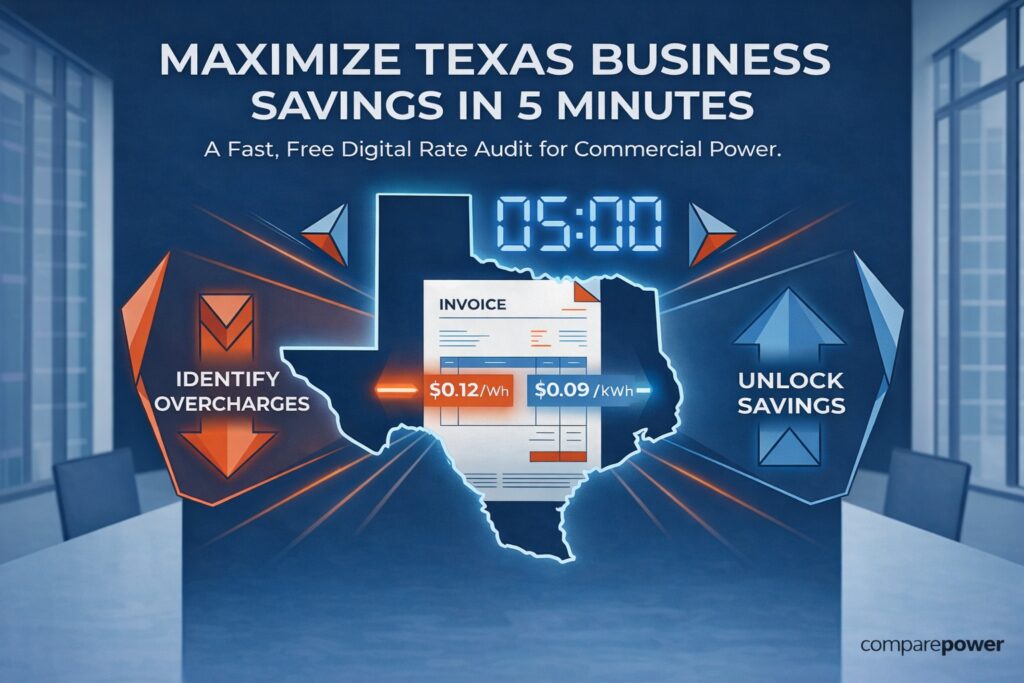
Audit Your Business Electricity Rate

Fixed vs Variable Electricity Rates for Business
What Is a Good kWh Rate for a Business in Texas?

How Long It Takes to Switch Business Electricity

How To Read Business Electricity Bill

Businesses Electricity Demand Charges

Business Electricity Contract Guide for Texas

Best Time to Renew Your Business Electricity in Texas
Commercial Electricity Rates Texas
How to Start Business Electricity Service in Texas

Restaurant Electricity Rates Texas