




Any product or company names, marks, or logos shown on this page are the property of their respective owners. ComparePower is an unaffiliated, independent marketplace. Get unbiased, accurate information backed by our commitment to editorial integrity.
Compare Texas Electricity Rates and Plans
The average Texas home pays 16.44 ¢/kWh for electricity, about 10.8% below the national average of 18.44 ¢/kWh. That is a gap of 2.00 ¢/kWh. The cheapest fixed-rate plan on our marketplace right now, in the Oncor service area, is 12.30¢ per kWh at 1,000 kWh.
Compare that marketplace number to the state average. The spread between them is not luck and it is not a rounding error. It is the difference between the plan a Texas household lands on by default and the plan they could have chosen. The rate on the ad is not the rate on your bill, because advertised rates are calculated at exactly 500, 1,000, or 2,000 kWh, and almost nobody uses exactly that.
Compare Power is an independent marketplace. We are not owned by a provider. We price every plan against your actual usage and tell you the truth, including when the truth is that your current plan is fine and you should stay put.
Rates as of August 2026 · Source: U.S. Energy Information Administration plus live Compare Power marketplace plans. Updated daily.
Key Takeaways
- Texas residential average: 16.44 ¢/kWh, about 10.8% below the national average of 18.44 ¢/kWh.
- Texas commercial average: 8.26 ¢/kWh, roughly 39.0% below the U.S. commercial average. Among the three cheapest states in the country.
- Competitive 12-month fixed plans currently run 12.4¢ to 14.9¢ per kWh. Judge every offer against that range.
- An average Texas household uses roughly 1,537 kWh in August, about 50% more than a mild spring month. Your summer bill is driven by usage, not by a rate increase.
Your August Bill Will Be Your Highest
Texas rates did not climb into this summer. They eased. Your August bill will still be the biggest one you get all year, because the average Texas household uses roughly 1,537 kWh in August against about 1,000 kWh in a mild spring month. Roughly 50% more electricity at a similar price is still a much larger bill.
That distinction matters, because providers blur it. A bill that jumps in August feels like the rate went up, which is the moment people accept a “summer relief” offer or a variable plan pitched as flexible. The rate did not go up. Usage did. The plan you should be on is the one that prices your August usage well, not the one that looks cheapest at a 1,000 kWh benchmark you only hit in October.
Texas Electricity Rates Right Now
Here is where every relevant average stands this month, and how each one moved from June.
| Average rate | August 2026 | June | Change |
|---|---|---|---|
| Texas residential | 16.44 ¢/kWh | 16.99 ¢/kWh | -0.55 ¢/kWh |
| U.S. residential | 18.44 ¢/kWh | 18.83 ¢/kWh | -0.39 ¢/kWh |
| Texas commercial | 8.26 ¢/kWh | 8.35 ¢/kWh | -0.09 ¢/kWh |
| U.S. commercial | 13.54 ¢/kWh | 13.51 ¢/kWh | +0.03 ¢/kWh |
Texas residential month-over-month change: -3.24%. EIA measures these at 1,000 kWh of monthly usage and publishes state-level rates two to three months behind. Updated May 2026.
Texas commercial customers pay 8.26 ¢/kWh, roughly 39.0% below the national commercial average of 13.54 ¢/kWh, a gap of 5.28 ¢/kWh. That puts Texas among the three cheapest states in the country for business power. The residential-to-commercial spread here is one of the widest anywhere, which is what happens when large buyers negotiate in a competitive wholesale market while households shop retail against marketing.
On our marketplace today, competitive 12-month fixed plans cluster between 12.4¢ and 14.9¢ per kWh at 1,000 kWh in the Oncor area. That is the band to judge an offer against. Anything advertised well below it is almost always a bill-credit plan that only prices that way inside a narrow usage window. The live table below shows real plans rather than a band, so you can check the claim yourself.
Electricity Rates by Service Area
Your rates depend on your Transmission and Distribution Utility, not your city name, because delivery charges are set per TDU and every retail plan is priced on top of them. Two neighborhoods in the same city can sit in different TDU territories.
| TDU service area | Cities served | 500 kWh | 1,000 kWh | 2,000 kWh |
|---|---|---|---|---|
| Oncor | Dallas, Fort Worth, Arlington, Plano, Irving, Grand Prairie, Waco, Midland, Odessa, Killeen | 14.00¢ | 12.30¢ | 12.10¢ |
| CenterPoint Energy | Houston, Katy, Sugar Land, Pasadena, Baytown, Galveston, The Woodlands | 16.80¢ | 11.60¢ | 13.80¢ |
| AEP Texas Central | Corpus Christi, Laredo, Victoria, Harlingen, McAllen | 15.40¢ | 10.40¢ | 11.70¢ |
Not sure which TDU serves you? Your ZIP code is the fastest way to find out, and parts of some cities fall outside the competitive market entirely. Garland is the clearest example: about 85% of the city is served by Garland Power & Light, a municipal utility with no retail choice, while the remaining Oncor pockets shop like the rest of Dallas-Fort Worth.
Live Texas Electricity Plans
Every plan below is a real offer available right now, priced at 1,000 kWh in the Oncor service area. Enter your ZIP above to reprice the whole list against your own usage and delivery charges.
These live rates for ONCOR ELECTRIC DELIVERY COMPANY service area were updated on . Pricing shown is based on an exact usage of 1000 kWh.
Electricity Rates by City
Understanding Your Electric Bill
Before we dive into the different electricity plan types and how to compare them, let’s first break down the key components of a typical Texas electric bill:
Delivery Charges (TDU): These are the fees charged by your local Transmission and Distribution Utility (TDU) to maintain the power lines and infrastructure that deliver electricity to your home. TDU charges make up around 30-40% of your total bill.
Energy Charge: The rate you pay per kilowatt-hour (kWh) of electricity used. It’s the part of your bill that fluctuates based on your actual usage.
Taxes and Fees: State and local taxes, as well as any additional regulatory fees, can add 5-10% to your total electric bill.
It’s important to understand these billing elements so you can accurately compare the true cost of different electricity plans, not just the advertised energy rate. We’ll dive deeper into that process in a bit.
Texas Electricity Plan Types
Fixed-rate plans lock your price per kWh for a set term, usually 6 to 36 months. Your rate does not move when the wholesale market does. This is the default correct answer for most households.
Variable-rate plans can change month to month at the provider’s discretion. They offer flexibility and no early termination fee, which is genuinely useful if you are moving in 60 days. They are a bad idea heading into a Texas August.
Time-of-use plans charge less during defined off-peak windows, often nights and weekends. These only work if your household can actually move heavy load into those windows. If your AC runs at 4 p.m. in August regardless, a time-of-use plan costs you money.
Prepaid plans are pay-as-you-go with usage alerts, and many require no deposit or credit check. Useful as a short bridge while you sort out a longer contract, expensive as a permanent arrangement.
Flat-rate plans bill one amount regardless of usage. You are buying predictability and you pay a premium for it. Providers price that premium assuming you use less than the cap.
Indexed plans tie your rate to a published wholesale index. You take on the provider’s price risk in exchange for upside in mild months. Most households should not.
Business electricity plans are custom-quoted on load profile and contract term. At the current Texas commercial average of 8.26 ¢/kWh, a business using 1,000 kWh a month pays about $82.60. Get a commercial quote.
How to Compare Texas Electricity Rates
Every Texas plan comes with an Electricity Facts Label, a standardized one-page disclosure required by the Public Utility Commission of Texas. The EFL is where the real cost lives, and it is the only document that lets you compare two offers honestly.
Pull these five items off every EFL you are considering:
- Average price per kWh at 500, 1,000, and 2,000 kWh. If those three numbers are far apart, the plan is usage-sensitive and the advertised rate is close to meaningless.
- Base charge or monthly service fee. A $9.95 monthly fee adds roughly a full cent per kWh at 1,000 kWh, and nearly two cents at 500 kWh.
- Usage credit thresholds. Note the exact window that triggers the credit, then check whether your real usage lands inside it in both January and August.
- Early termination fee. Compare it against what you would save by leaving.
- Whether TDU delivery charges are included. Some EFLs quote energy-only. Delivery adds roughly 4 to 5 cents per kWh.
To estimate a monthly bill from an EFL:
(energy charge per kWh × your kWh) + base charge + TDU delivery charges = your bill
Then run that calculation twelve times, once per month of your real usage history. That is the number that matters, and it is the number providers never advertise.
Why the Cheapest Advertised Rate Often Costs the Most
The plan at the top of a sorted list is frequently the worst plan on the page. Four reasons:
Advertised rates are benchmarks, not prices. They are calculated at exactly 500, 1,000, or 2,000 kWh. Use 1,050 kWh instead of 1,000 and your effective rate can move by several cents.
Bill credits cut both ways. A plan advertising 8.9 cents at 1,000 kWh may be running a $100 credit that only applies between 1,000 and 2,000 kWh. Land at 950 kWh in October and you pay the unsubsidized base rate, often 16 cents or higher. Providers know your usage varies. That is the design, not an accident.
Seasonal swings break single-point pricing. A Texas household might use 900 kWh in November and 1,600 kWh in August. Any plan optimized for one of those numbers is wrong for the other.
Contract length decides when you shop next, and that has a price. A 12-month term signed in August puts your next renewal in August 2027, back in peak summer. A 9-month or 15-month term lands you in spring, historically the cheapest window. Contract length is a scheduling decision as much as a pricing one, and most shoppers never think about it.
Live Link solves the underlying problem. It pulls your actual 12-month usage history directly from your utility, then prices every available plan against your real consumption month by month. No estimating and no guessing which benchmark you resemble. See what you would actually pay with Live Link.
When to Shop for Electricity in Texas
Texas electricity prices follow a seasonal pattern stable enough to plan around. Rates are typically lowest in spring, March through May, when demand is mild. They firm through summer and are usually highest around the August peak. They ease again in fall, September through November, then tick up for winter heating season. A severe cold snap can spike winter pricing without warning, as February 2021 demonstrated.
The practical rule: spring and fall are the good windows. June through August is the worst. January and February are second worst.
If your contract expires in August, you do not get to wait for a better window. In that situation the correct move is still to lock a fixed rate rather than roll onto a month-to-month holdover rate, which is typically the most expensive electricity a Texas household can buy. Pick a term length that puts your next renewal in spring.
Summer 2026 Playbook
Price plans against your real usage, not the 1,000 kWh benchmark. Your August bill is set by your August usage. Live Link shows you all twelve months.
Do not ride a variable rate into August. Variable and indexed plans float with the wholesale market, and Texas summers are when scarcity pricing does the most damage. A plain fixed rate is the safe call.
Choose your term length deliberately. Avoid a straight 12-month term signed in summer, which drops your next renewal right back into peak season. A 9-month or 15-month term moves it into spring.
Be skeptical of bill credits, free nights, and seasonal discounts. Total the whole year before you decide. Most of these structures cost more than a plain fixed rate once you account for the months you miss the threshold.
Longer terms are not automatically cheaper right now. The wholesale forward curve has been in contango since August 2025, meaning 2027 and later contracts trade at a premium to near-term power. A 24 or 36-month fixed plan may still be worth it for the certainty and for protection against ERCOT demand growth, but do not sign one believing you are capturing a discount. Compare the actual 12, 24, and 36-month prices on your ZIP and decide from the numbers.
It is not your fault that this is confusing. It was built to be confusing. We have already done the math, so you can get back to your day confident you are not overpaying.
Who Can Choose a Provider in Texas
Texas opened its retail electricity market to competition in 2002 under Senate Bill 7. Roughly 85% of Texans now live in an area where they choose their own Retail Electric Provider. The other 15% cannot, and the page you are reading does not apply to them.
You cannot choose a provider if you are served by:
- A municipally owned utility. Austin Energy, CPS Energy in San Antonio, Garland Power & Light, Denton Municipal Electric, Brownsville Public Utilities Board, Bryan Texas Utilities, and roughly 70 others.
- An electric cooperative. Pedernales, Bluebonnet, CoServ, Trinity Valley, and dozens more, mostly rural. A small number of co-ops have opted into competition.
- A utility outside the ERCOT grid. El Paso Electric in far West Texas, Southwestern Public Service in the Panhandle, and Southwestern Electric Power and Entergy Texas in parts of East Texas.
Where competition does apply, three parties are involved. Your TDU owns the poles and wires, delivers your power, reads your meter, and restores service after an outage. You cannot choose it and it cannot sell you electricity. Your REP is the company you buy from and the company that bills you. ERCOT operates the grid, dispatches generation, and runs the wholesale market and the switching protocols. Retail conduct rules, disclosure requirements, deposit and disconnection rules, and complaint resolution are the responsibility of the Public Utility Commission of Texas under Chapter 25 of the Texas Administrative Code, not ERCOT.
Read the full guide to Texas electricity deregulation.
What Is Actually on Your Texas Electric Bill
Three components, and only one of them is competitive.
Energy charges come from your REP at the rate in your contract. This is the only part shopping can change.
TDU delivery charges are set by your utility, approved by the PUCT, and passed through without markup. They typically run 30% to 40% of a residential bill and are identical across every REP in your service area. Any provider claiming lower delivery charges is misrepresenting how the market works.
Taxes and regulatory fees add roughly 5% to 10%, including state sales tax, any municipal fee, and the PUCT assessment.
See a line-by-line breakdown of a real Texas electric bill.
Texas Electricity Rate History
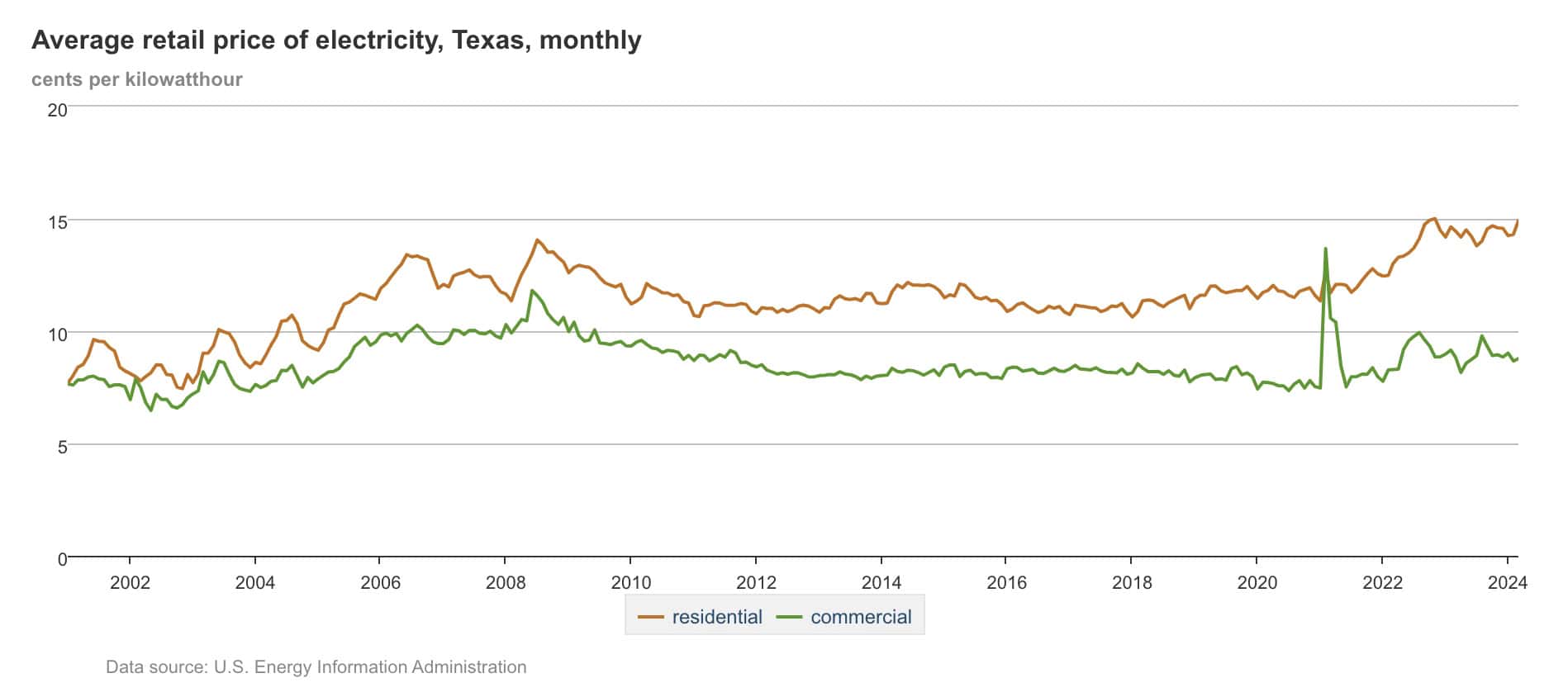
The chart tracks residential and commercial rates over time. Two patterns are worth noticing. Residential rates show pronounced summer peaks as statewide air conditioning load stresses the grid, while commercial rates stay comparatively flat because large buyers hedge on longer terms. And the residential-commercial gap has widened over the past several years, which is what a competitive wholesale market attached to a retail market full of marketing looks like from the outside.
Texas Electricity Rates FAQs
Confused about Texas electricity rates? Here’s what you need to know.
What is the average electric bill in Texas?
About $164.40 per month at 1,000 kWh, based on the current statewide residential rate of 16.44 ¢/kWh. Summer bills run substantially higher. A household using 1,600 kWh in August at a competitive fixed rate pays roughly $230 to $290, and a large or poorly insulated home can exceed $400. A business using 1,000 kWh pays about $82.60 at the commercial average.
What is a good electricity rate in Texas right now?
Competitive 12-month fixed plans currently run 12.4¢ to 14.9¢ per kWh, against a statewide average of 16.44 ¢/kWh. If your all-in rate is inside that band you are doing fine. Above it, you are probably on a holdover rate or an expired contract. Advertised rates well below the band are usually bill-credit plans that only price that way at one usage level.
Are Texas electricity rates going up or down?
The Texas residential average is 16.44 ¢/kWh this month, against 16.99 ¢/kWh in June. Month-over-month change: -3.24%. The national average moved from 18.83 ¢/kWh to 18.44 ¢/kWh over the same period. Month-to-month movement is driven mostly by natural gas prices and delivery-infrastructure costs. Note that a falling average rate does not mean falling summer bills, because August usage runs about 50% above a mild month.
Should I switch electricity plans in the middle of summer?
It depends on where your contract stands. If you are still inside a fixed-rate term, sit tight and plan to shop in fall when rates typically ease. If your contract has expired or you are on a variable or holdover rate, switch now. Holdover rates are the most expensive electricity in Texas and August is the worst month to be paying one. Do not wait for a better window that arrives after your highest-usage month.
How do I compare Texas electricity rates and find the best plan?
Start with your last twelve electric bills and write down your kWh for each month. Then compare plans against that full pattern rather than a single benchmark. Read the Electricity Facts Label for every plan you are seriously considering and check the average price at 500, 1,000, and 2,000 kWh, the base charge, any usage-credit threshold, and the early termination fee. If the three average prices differ significantly, the plan is usage-sensitive. Live Link automates all of this by pulling your real usage history from your utility.
Who has the cheapest electricity rates in Texas?
There is no single cheapest provider, and any site that names one is guessing or getting paid. Cheapest depends on your TDU service area, your usage level, and your usage pattern across the year. A plan that is cheapest at 1,000 kWh can be among the most expensive at 850 kWh. Gexa Energy, Frontier Utilities, and Rhythm Energy frequently post competitive rates, while TXU, Reliant, and Green Mountain compete more on brand and service than on price. The only reliable answer comes from pricing plans against your own usage.
Why is my Texas electric bill so high?
If it is only high in July, August, and September that is air conditioning load and it is largely unavoidable. If it is high in mild months too, the plan is the problem. The three usual culprits: an expired fixed contract that rolled to a month-to-month holdover rate, a variable-rate plan the provider has been quietly raising, or a bill-credit plan where your usage keeps landing outside the threshold. All three are common and none of them are your fault.
Who has the best electric rates in Texas?
It varies by provider, location, and your usage pattern. TXU, Reliant, and Green Mountain Energy often have competitive rates. Read reviews, compare plans based on your actual usage level, and review the EFL before committing.
Will Texas electricity rates go down in 2026?
Rates typically ease from September through November as summer demand fades, and that seasonal pattern is reliable. The longer-term direction is not. ERCOT demand is growing quickly, driven largely by data centers and industrial load, which puts upward pressure on wholesale prices. Solar and battery additions push the other way. Forward markets have priced 2027 and beyond at a premium to near-term power since August 2025, which tells you traders expect tightening. Nobody can guarantee future rates, and anyone who does is selling something.
Can everyone in Texas choose their electricity provider?
No. Roughly 85% of Texans can. You cannot choose if you are served by a municipal utility such as Austin Energy, CPS Energy in San Antonio, or Garland Power & Light, or by most electric cooperatives, or by a utility outside the ERCOT grid, which covers El Paso, the Panhandle, and parts of East Texas. Enter your ZIP code to confirm whether your address is in a competitive area.
Is there a cap on Texas electricity rates?
No retail price cap exists. Retail rates are set by competition among providers. The Public Utility Commission of Texas regulates market conduct and disclosure under Chapter 25 rather than setting prices. A separate wholesale price cap applies to the ERCOT spot market, which affects generators and indexed plans but does not limit what a REP can charge on a retail contract.
How does the Texas electricity grid work?
ERCOT operates an independent grid covering about 90% of Texas load and roughly 27 million customers. It is not synchronously connected to the two national grids, which is why Texas cannot import significant power during a shortage and why it also falls outside most federal transmission jurisdiction. Generation comes from natural gas, wind, solar, nuclear, coal, and a fast-growing fleet of batteries. High-voltage lines carry it to local TDUs, which deliver it to homes and businesses.
What is the cheapest electricity provider in Texas?
There is no single “cheapest” electricity provider in Texas, as rates can vary significantly by location, usage, plan type, and provider offerings. The best way to find the most affordable electricity plan for your home is to compare quotes from multiple providers using a free marketplace like Compare Power.
What percentage of Texas electricity comes from renewable sources?
Natural gas supplied about 43% of ERCOT generation over the first nine months of 2025, while wind and solar together met roughly 36% of demand. The renewable share keeps climbing. EIA forecasts solar generation in ERCOT will exceed coal for the first full year in 2026, and Texas is expected to account for about 40% of all utility-scale solar capacity added in the United States this year. For a live fuel mix, see the ERCOT Fuel Mix dashboard.
How can I lower my electricity bill in Texas?
Some of the best ways to lower your electricity bill in Texas include:
– Comparing electricity plans and providers regularly
– Selecting the right plan type (fixed, variable, etc.) for your needs
– Reducing your electricity usage through energy-efficient upgrades
– Taking advantage of rewards programs and bill credits from providers
– Timing your electricity shopping to capitalize on seasonal rate patterns
Is there a cap on electricity rates in Texas?
No, there is no legal cap or price ceiling on electricity rates in Texas’ deregulated market. Rates are determined by market competition among Retail Electric Providers. However, the state’s Public Utility Commission does monitor the market and can intervene if it determines rates have become unreasonably high.
How does the Texas electricity grid work?
Texas has its own independent electric grid, known as ERCOT (Electric Reliability Council of Texas), which is not interconnected with the rest of the country. ERCOT is responsible for managing the flow of electric power to more than 26 million Texas customers and ensuring the reliability of the state’s electric system.
Within the ERCOT grid, electricity is generated by a variety of sources, including natural gas, coal, nuclear power, wind, and solar power. This power is then transmitted across high-voltage power lines and distributed to homes and businesses by local utility companies known as Transmission and Distribution Utilities (TDUs).
What percentage of Texas’ electricity comes from renewable sources?
As of late 2025, renewable energy sources (wind and solar) accounted for 28.1% of total electricity generation on the ERCOT grid. This represents a significant increase from previous years as Texas continues to expand its investments in wind and solar power. The state’s current fuel mix is: Natural Gas (48.1%), Wind (20.7%), Coal (13.0%), Solar (7.5%), Nuclear (10.6%), Battery Storage (-0.3%), and Other (0.1%).
How do Texas electricity prices compare to other states?
Texas residential rates run 16.44 ¢/kWh against a national average of 18.44 ¢/kWh, about 10.8% below, or 2.00 ¢/kWh cheaper per kWh. That puts Texas near the middle of the pack nationally: far cheaper than Hawaii, California, and New England, and more expensive than low-cost states such as North Dakota, Nebraska, and Louisiana. On commercial rates Texas is genuinely near the bottom, at 8.26 ¢/kWh against a national commercial average of 13.54 ¢/kWh, roughly 39.0% below.
Bottom Line
Texas households pay 16.44 ¢/kWh on average, 10.8% below the rest of the country, and you can choose your provider. Neither of those facts protects you from the wrong plan. The households that overpay in Texas are almost never the ones who chose badly. They are the ones whose contract quietly expired and rolled to a holdover rate, or who took an advertised number at face value without checking whether their usage matched the benchmark it was calculated at.
Enter your ZIP code, price the plans against your real usage, and find out in a few minutes whether you are on the right one. Sometimes the answer is that you already are.
Rate data from the U.S. Energy Information Administration, measured at 1,000 kWh of monthly usage. Updated May 2026. EIA publishes state-level rates with a two to three month reporting lag. Marketplace rates are live and reflect plans available at time of page load.
Our Texas-based energy experts are here to help:
Live Chat (bottom right, Mon-Fri: 8:30 AM – 6:30 PM)
Call 855-441-3030 (Mon-Fri: 8:30 AM – 6:30 PM Sat: 9 AM – 4:30 PM)
Email [email protected]
Why Texans Trust Compare Power
With more than 81,590 five‑star reviews, Compare Power is Texas’ top electricity marketplace. We’re independent, transparent, and built to help you find value—not gimmicks. Enroll instantly online and start saving on your next bill.
Stay Informed with Our Latest Articles
We regularly publish tips to help you understand your options, make wise choices, and avoid overpaying for electricity. Check out our latest posts to stay ahead of the curve.

How to Choose Your Texas Electricity Company

How to Lower Your Electricity Bill

Get Power ON Today

Apartment Electricity

Usage-Based Shopping

Best Time to Switch Electric Providers in Texas
Electricity Contract Expiration Guide
Browse rates in all Texas cities
Dallas, Houston, and the other big names above are a fraction of the market. ComparePower tracks live rates and plans for 889 deregulated Texas cities — from Abbott to Zavalla — priced against your actual usage, not the advertised benchmark.
See every Texas city we cover →
ComparePower’s full article library — 208 guides on rates, plans, bills, and the fine print providers hope you skip — now lives on one page. Browse every guide we’ve published →