



Any product or company names, marks, or logos shown on this page are the property of their respective owners. Compare Power is an unaffiliated, independent marketplace. Get unbiased, accurate information backed by our commitment to editorial integrity.
The Billing Errors Hiding in Plain Sight
Roughly 17% of commercial electricity invoices contain a billing error of some kind. That is worth checking. But the biggest cost problem on most Texas business electricity bills is not a billing error. It is the rate itself.
Key Takeaways:
- A free rate audit compares what you are currently paying to what competing providers offer for the same usage at the same address, and the gap averages 15 to 30 percent.
- Three line items hide the most common overcharges on Texas commercial bills: demand charges you did not know existed, TDU passthrough markups, and holdover rates after contract expiration.
- Roughly 17 percent of commercial electricity invoices contain a billing error, but the biggest cost problem on most Texas bills is the rate itself, not the math.
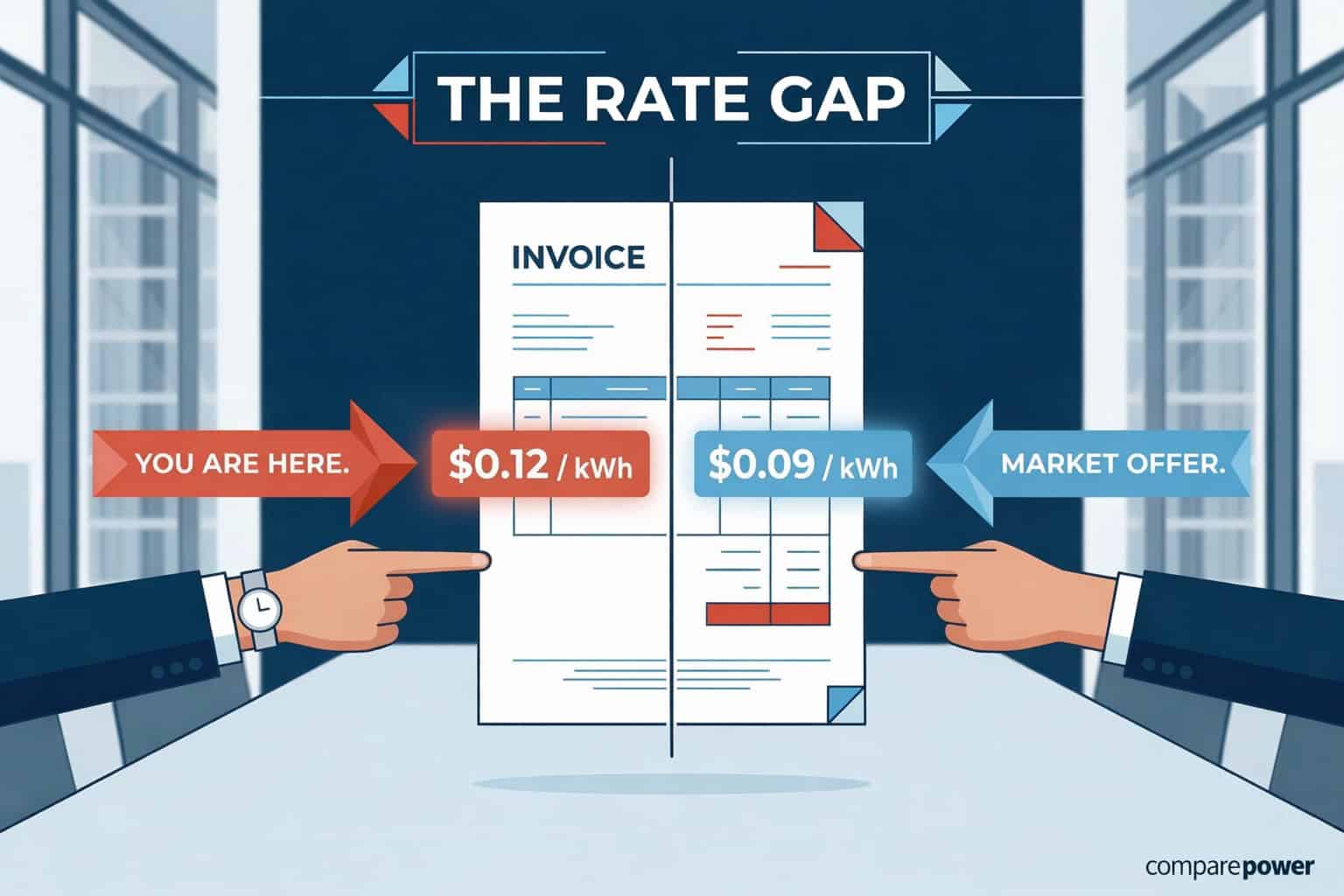
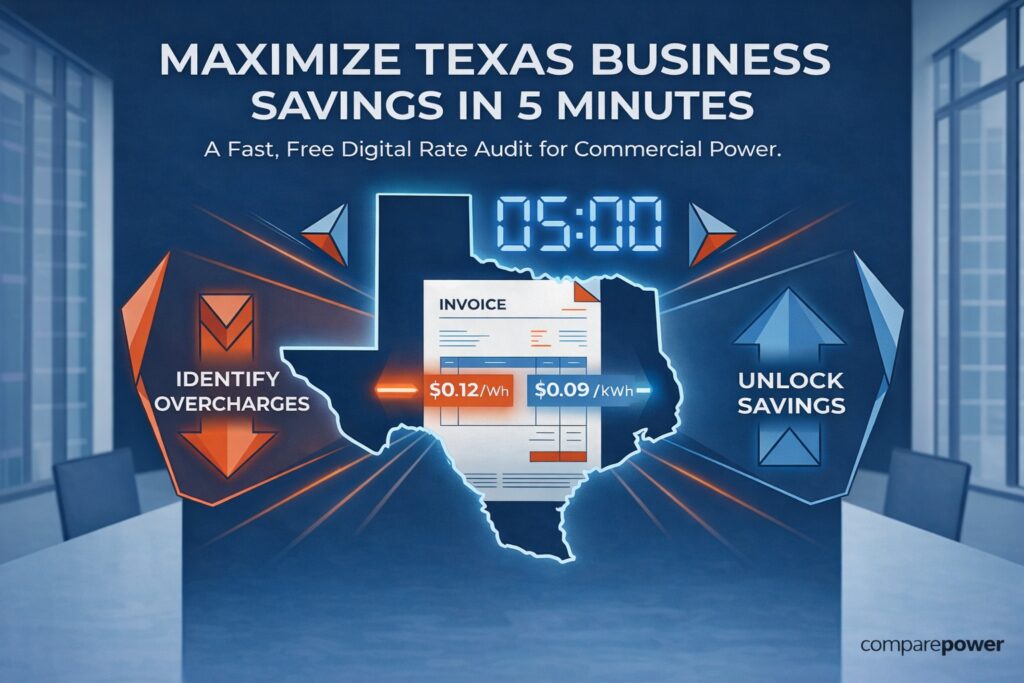
A rate audit compares what you are currently paying per kWh to what competing providers are offering for the same usage at the same address. In a deregulated market with over 100 retail electricity providers, the gap between your current rate and the best available rate can be significant. Businesses that auto-renewed or have not compared rates in two or more years are often paying 15-25% above market.
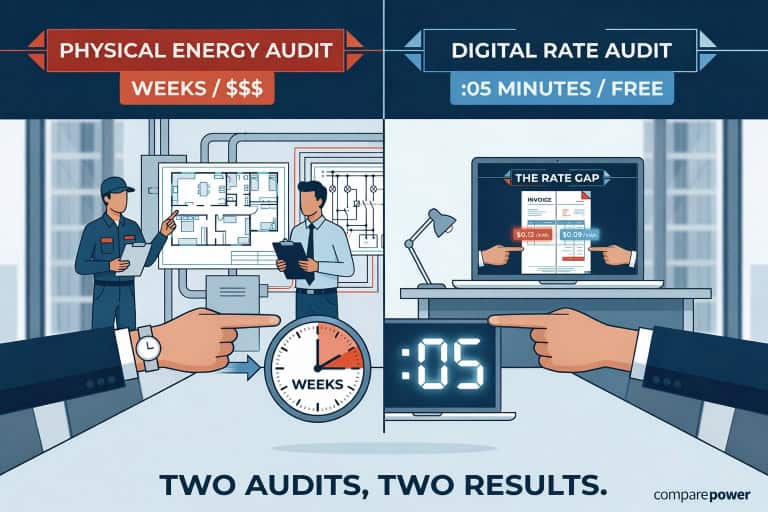
The good news: unlike a physical energy audit that costs thousands of dollars and takes weeks to complete, a rate audit takes about five minutes and costs nothing. You need your current rate per kWh and a willingness to see what the market is actually offering. If you have never looked at your bill line by line, our guide to reading your business electricity bill covers every charge and what it means.
By the end of this page, you will know whether your business is overpaying for electricity and exactly what to do about it.
A Rate Audit and an Energy Audit Are Two Different Things
Most business owners hear “energy audit” and picture someone inspecting their HVAC system with a clipboard. That is a physical energy audit. It evaluates your building’s equipment, insulation, lighting, and operational efficiency. It costs $500 to $5,000 or more depending on facility size. It takes two to eight weeks. It is valuable, but it is not what most overpaying businesses need first.
A rate audit is different. It compares the rate on your current electricity contract to the rates available from other providers in your service territory right now. It costs nothing. It takes minutes. And for most Texas businesses, it reveals more savings than a physical audit ever would.
Here is why: a business paying 12 cents per kWh when 9-cent rates are available in the same ZIP code is overspending $300 per month on every 10,000 kWh of usage. That is $3,600 per year from the rate alone. No amount of LED bulb swaps or thermostat adjustments produces that kind of savings that quickly.
Both audits have value. But start with the one that costs nothing and produces results the same day.
Three Signs Your Business Is Overpaying for Electricity
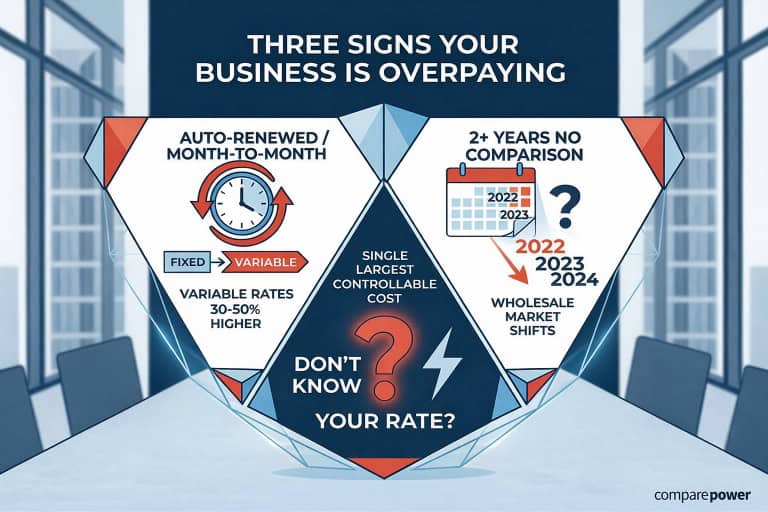
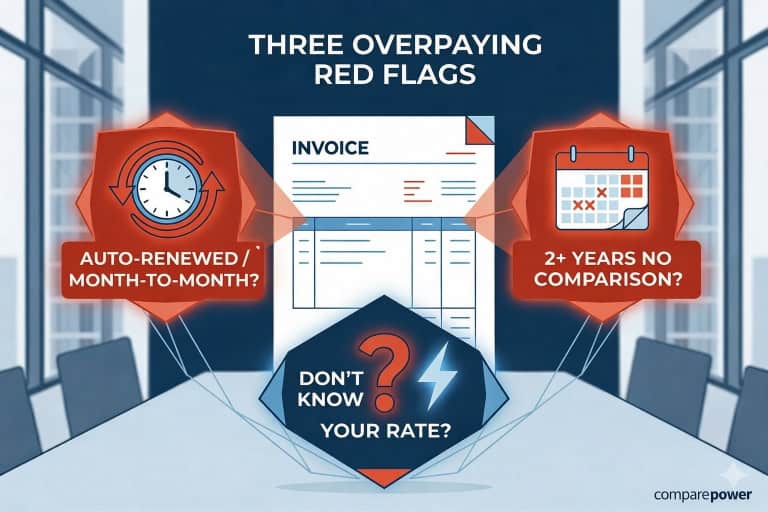
Not every business needs a rate audit right now. But if any of these three conditions apply to you, a rate audit will almost certainly reveal savings.
You auto-renewed or rolled to a month-to-month rate. When a fixed-rate contract expires in Texas, your provider moves you to a variable month-to-month rate that is typically 30-50% higher than your locked rate. Even if your provider sent a renewal offer, that offer is built from their retention margin. Renewal rates run 15-25% above what a new customer would pay for the same usage at the same address. If you accepted a renewal offer without comparing it to the open market, you are likely overpaying.
You have not compared rates in two or more years. Texas wholesale electricity prices shift as natural gas markets, demand patterns, and generation capacity change. A rate that was competitive in 2024 may not be competitive in 2026. With over 100 providers competing for commercial accounts, the spread between the highest and lowest available rates in any given ZIP code is meaningful. Two years without a rate comparison is too long in a market that moves this quickly.
You do not know your current rate per kWh. If you cannot state your energy rate without pulling up a bill, nobody in your organization has audited it. The rate on your contract is the single largest controllable cost on your electricity bill. If you do not know the number, you cannot know whether it is competitive.
For businesses approaching renewal, our renewal timing guide covers the specific windows where rate comparisons produce the best results.
How to Audit Your Business Electricity Rate in 5 Minutes
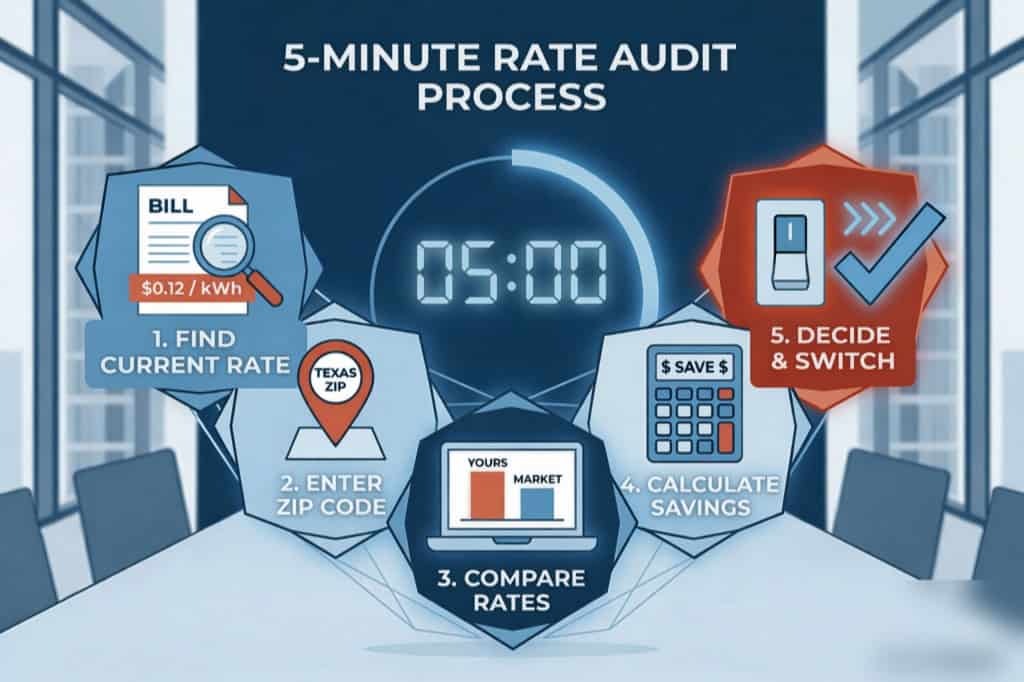
A rate audit does not require a consultant, a site visit, or weeks of analysis. For Texas businesses in the deregulated market, the process takes five steps and five minutes.
Step 1: Find your current rate per kWh. Pull your most recent electricity bill or your Electricity Facts Label (EFL). Look for the energy charge per kWh. This is the rate your provider charges for the electricity itself, separate from TDU delivery charges. If your bill shows a bundled “all-in” rate, note that number instead.
Step 2: Compare available commercial rates on ComparePower. Your address determines your TDU service territory, which determines which providers and rates are available at your location. Different areas within the same city can have different rate options.
Step 3: Compare your current rate to the lowest available fixed rates. Look at fixed-rate plans for your approximate monthly usage level. Compare the energy charge (or all-in rate if that is what your current bill shows) to what providers are quoting right now.
Step 4: Calculate your annual savings. Take your current rate, subtract the best available rate, and multiply by your monthly kWh usage, then multiply by 12. For example: (11 cents minus 9 cents) times 10,000 kWh times 12 months equals $2,400 per year.
Step 5: Decide whether the savings justify a switch. If the annual difference is $500 or more, switching providers is almost certainly worth your time. If the difference is under $200, your current rate is competitive enough that the effort of switching may not make sense. Between $200 and $500, it depends on how much the process matters relative to the savings.
The rate comparison itself IS the rate audit. The tool shows you what the market offers. Your bill shows you what you are paying. The gap between those two numbers is your answer. For a full list of commercial rates by provider, that page updates as providers publish new plans.
The Three Line Items That Hide Overcharges on Texas Business Bills
Your energy rate is the largest controllable cost on your bill, but it is not the only place overcharges hide. Three specific line items on Texas commercial electricity bills deserve scrutiny during any audit.
TDU delivery charges account for 40-50% of your total bill. These charges come from your Transmission and Distribution Utility, not your retail provider. They are regulated by the Public Utility Commission of Texas and update twice per year: March 1 and September 1. If your bill still reflects pre-March rates after a March update, or pre-September rates after a September update, you may have been overcharged. Verify your TDU charges against the approved rates for your service territory. The charges should match your EFL exactly.
Demand charges can represent 30-50% of a mid-market commercial bill. If your account has a peak demand above 50 kW, your bill likely includes a demand charge based on your highest 15-minute usage interval during the billing period. Check that the peak demand measurement on your bill aligns with your actual operations. A single equipment startup spike or an unusual operational day can set your demand charge for the entire month. For a full breakdown of how demand charges work and how to manage them, that guide covers every detail.
Fees and surcharges not listed on your original EFL. Your Electricity Facts Label is the binding disclosure of what your provider agreed to charge you. If you see line items on your bill that do not appear on your EFL, you have grounds to dispute them. Some providers add administrative fees, paper billing surcharges, or regulatory recovery charges that were not part of the original contract disclosure. Pull your EFL and compare it to your bill line by line.
Your Renewal Offer Is Not a Market Rate
The single most expensive “billing error” on Texas business electricity bills is not technically an error at all. It is accepting a renewal offer without checking the open market first.
Here is how renewal pricing works: your current provider calculates a renewal rate based on keeping you as a customer, not on giving you the best available price. They factor in the probability that you will accept without shopping around. That probability is high. Most businesses renew without comparing.
The result: renewal offers run 15-25% above rates available to new customers at the same address with the same usage profile. On a 10,000 kWh per month account, the difference between an 11-cent renewal offer and a 9-cent market rate is $200 per month or $2,400 per year. On a 50,000 kWh account, that same 2-cent gap costs $1,000 per month or $12,000 per year.
The fix: at every renewal cycle, compare your renewal offer against at least three competing providers before signing anything. The five-minute rate audit described above is exactly this process. It catches the biggest overpayment most Texas businesses face.
For a full walkthrough of what to look for in renewal offers and new contract terms, that guide covers every clause that affects your bottom line.
When a Rate Audit Will Not Save You Money
Here is the section most landing pages skip: an honest assessment of when a rate audit will not produce savings.
If you signed a competitive fixed-rate contract within the last 12 months after comparing multiple providers, your rate is probably fine. The market has not moved dramatically enough in that timeframe to create a significant gap between what you locked in and what is available now.
If your current rate is already at or below 8.60 ¢/kWh cents per kWh (the Texas commercial average as of February 2026), the savings from switching to a marginally lower rate may not justify the administrative effort of changing providers. A half-cent-per-kWh improvement on 10,000 kWh per month saves $600 per year. That is meaningful, but it depends on how much you value the time involved.
If you are locked into a long-term fixed contract with an early termination fee (ETF), the fee may exceed the rate savings available from switching. Before breaking a contract, calculate whether the ETF is less than the annual savings. If your current contract has six months remaining and the ETF is $500, but the annual savings from switching is $1,200, the math works. If the ETF is $2,000 and the savings is $800 per year, it does not. Our switching guide walks through the ETF calculation step by step.
The honest bottom line: not every audit reveals savings. But the audits that do reveal savings typically find thousands of dollars per year. The five-minute investment to check is worth it at every renewal cycle.
Business Electricity Rate Audit FAQ
What is a business electricity rate audit?
A business electricity rate audit compares the rate on your current electricity contract to the rates available from competing providers in your service territory. It identifies whether your business is paying more per kWh than the market requires. In the Texas deregulated market, a rate audit means checking your current rate against offers from 100+ providers that serve your ZIP code. A rate audit is different from a physical energy audit, which evaluates your building’s equipment and efficiency.
How much does an electricity rate audit cost?
A rate audit costs nothing. You need your current rate per kWh (from your bill or EFL). Compare business electricity rates on Compare Power to see what providers are offering for commercial accounts in your area. The comparison itself is the audit. Physical energy audits, which inspect equipment and building efficiency, cost $500 to $5,000 or more depending on facility size.
How do I know if my business is overpaying for electricity?
Three indicators suggest your business is overpaying: you auto-renewed or rolled to a month-to-month rate after your contract expired, you have not compared rates from competing providers in two or more years, or you do not know your current rate per kWh. If any of these apply, a rate audit will likely reveal savings. The average Texas commercial rate is 8.60 ¢/kWh cents per kWh as of February 2026. If your rate is significantly above that average, a comparison is worth five minutes.
What is the difference between a rate audit and an energy audit?
A rate audit compares your electricity rate to market alternatives. It is free, takes minutes, and identifies rate overpayments. An energy audit inspects your physical facility (HVAC, lighting, insulation, equipment) to find efficiency improvements. It costs $500 to $5,000+, takes weeks, and identifies operational savings. A rate audit should come first because it requires zero investment and often reveals larger immediate savings than a physical audit.
How often should I audit my business electricity rate?
Audit your rate at every contract renewal cycle, which for most commercial accounts is every 12 to 36 months. Also audit your rate if wholesale market conditions have changed significantly since you signed your current contract. At minimum, compare rates once per year to confirm your current contract remains competitive. The Texas deregulated market shifts as natural gas prices, demand growth, and new generation capacity change the supply-demand balance.
Can I audit my electricity rate if I am still under contract?
Yes. Knowing your position in the market does not require you to switch. Auditing your rate while under contract tells you whether to begin shopping before your renewal window opens or whether your current rate is competitive enough to hold. If you find rates significantly lower than your current contract, note the savings and begin your provider comparison 60-90 days before your contract expires to capture the best available rate at renewal.
Our Texas-based energy experts are here to help.
Live Chat (bottom right, Mon-Fri: 8 AM – 6 PM)
Call 469-813-8854 (Mon-Fri: 8 AM – 6 PM)
Email [email protected]

How to Switch Business Electricity in Texas
Audit Your Business Electricity Rate

Fixed vs Variable Electricity Rates for Business
What Is a Good kWh Rate for a Business in Texas?

How Long It Takes to Switch Business Electricity

How To Read Business Electricity Bill
Businesses Electricity Demand Charges

Business Electricity Contract Guide for Texas

Best Time to Renew Your Business Electricity in Texas

Commercial Electricity Rates Texas

How to Start Business Electricity Service in Texas

Restaurant Electricity Rates Texas