


Los nombres de productos o empresas, marcas o logotipos que aparecen en esta página son propiedad de sus respectivos propietarios. Compare Power un mercado independiente y no afiliado. Obtenga información imparcial y precisa respaldada por nuestro compromiso conla integridad editorial.
Why Restaurants Pay More Per Square Foot Than Any Other Business
Your electricity bill doesn’t lie. Restaurants consume 43.8 kWh per square foot annually. That’s 248% higher than average commercial buildings. If you run a fast-food operation, the number is worse: 62.8 kWh per sq ft, which is 398% above the baseline.
Principales conclusiones:
- Restaurants consume 43.8 kWh per square foot annually, which is 248 percent higher than average commercial buildings, driven by constant refrigeration, cooking equipment, and ventilation.
- ERCOT 4CP demand charges and the morning startup problem (when all equipment powers on simultaneously) create peak demand spikes that can add $200 to $500 per month to a restaurant bill.
- Kitchen equipment scheduling, walk-in cooler maintenance, and HVAC pre-cooling before peak hours are the three highest-impact tactics for reducing restaurant electricity costs.
You’re not overspending because you’re careless. Kitchens are power-intensive machines. Constant refrigeration (39-45% of total use), cooking equipment (22-35%), and ventilation systems (12% baseline, far higher when combined with hood systems) never sleep. Add Texas’s deregulated market layers, and most restaurant owners are left guessing at their bills.
Here’s the reality: Texas is actually 37% below the national average for commercial electricity rates. The state’s deregulated market gives you 130+ retail providers to choose from. Typical restaurant bills in Texas run $2,000-6,000 monthly, but you’re not just paying for energy consumption. Demand charges can represent 30-70% of your total bill. That’s the hidden multiplier nobody warns you about.
This article decodes how your bill actually works, where your energy goes, and what moves actually cut costs. Not theoretical savings. The ones that work for restaurants that have thin 3-5% profit margins and seasonal peaks that concentrate your energy use into summer months when rates spike. You’ll discover which upgrades have the fastest payback (LEDs), which require the most discipline (demand staggering), and which are best saved for the next equipment replacement cycle (hood systems). By the end, you’ll know exactly what to focus on first.o-renewal at inflated rates represents hundreds of millions in annual overpayment across Texas businesses.ercial rates, how far in advance to start shopping based on your business size, and the negotiation tactics that drop your rate before you sign anything.
Índice
The Complete Breakdown
Most restaurant owners see one number on their bill and assume that’s electricity. Actually, you’re seeing three separate pieces stacked together, and one of them is invisible in plain sight.
Energy charges are simple consumption math: kilowatt hours (kWh) used times your rate. For example, 10,000 kWh at 9.22 cents per kWh equals $922. That part is predictable. Your usage changes seasonally (more cooling in summer, more heating in winter), but the math is simple.
Demand charges are the hidden multiplier that separates restaurants who know their bills from those who are constantly surprised. These are measured in 15-minute intervals. One single 15-minute interval of peak demand can account for 30% or more of your power costs and roughly one-third of your annual utility bill. Unlike energy charges that track your total consumption, demand charges freeze at the highest 15-minute power draw your restaurant hit in any given month.
A restaurant with 150 kW peak demand at $15 per kW is looking at $2,250 in demand charges alone. That’s $27,000 per year from one single metric. Many restaurant owners have never seen this line item broken out separately, which is why it blindsides them when comparing bills. (For a deeper dive, see our demand charges explained guide.)
TDU delivery charges are the third component and separate from energy supply. These vary by service territory and typically add 3 to 5 cents per kWh. Dallas-Fort Worth, Houston, and other territories all have different delivery costs and different structures. These charges are non-negotiable. You cannot shop around for them. Your TDU (transmission and distribution utility) is determined by your address. When you combine energy charges, demand charges, and TDU delivery, typical all-in rates for restaurants range from 8.5 to 13 cents per kWh depending on territory and load profile.
Know both components (energy and demand) or demand charges will blindside you when your bill spikes. Some months, a single high-demand event during lunch or dinner service can set your billing demand for the entire month. That’s how the system works. TDU charges are fixed by location and negotiation-proof. Energy supply charges are where you can shop and save.
Where Your Restaurant Energy Goes That Kitchen vs Front-of-House
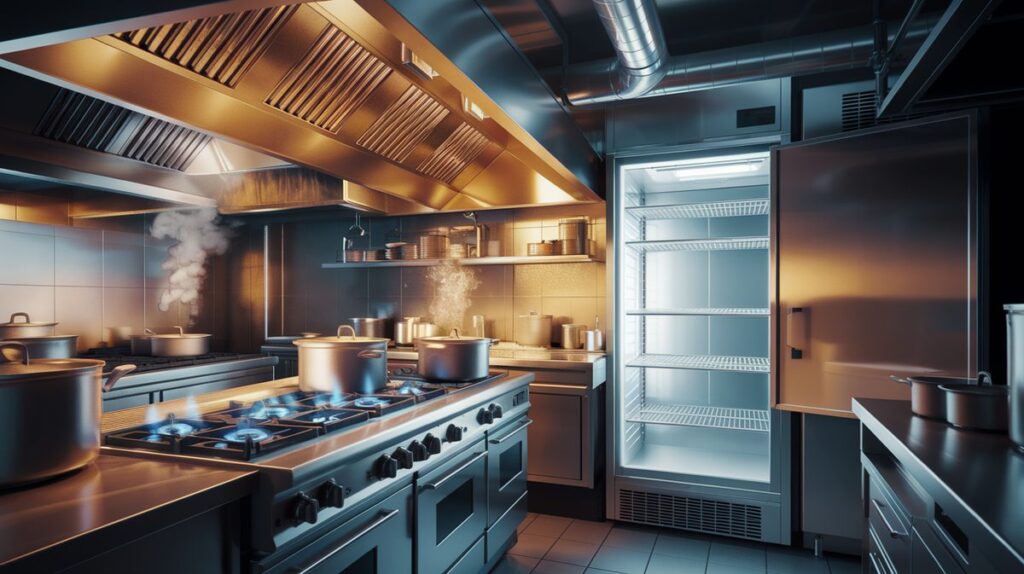
Ventilation hood systems and cooking equipment make up about 80% of commercial kitchen energy consumption. This fact surprises most restaurant owners. You probably assumed refrigeration is the top energy drain. It’s not by itself. It’s the combination of refrigeration running 24/7 plus hood systems running continuously during service hours.
Refrigeration is the single largest individual consumer at 39-45% of total use, representing roughly 350 kWh to 450 kWh daily for a mid-size restaurant. Walk-in coolers use 5-30 kWh per day depending on size, age, and temperature settings. An 8×8 cooler costs $70-150 monthly on your electricity bill. Walk-in freezers triple that energy demand and are the second-most expensive kitchen piece to cool. The same 8×8 freezer runs $240-435 monthly. Both run even during closed hours to maintain temperature stability, which is why they show up on your off-hours demand meter.
When was the last time you audited your walk-in temperatures (should be 35-38°F for coolers, -10 to 0°F for freezers) or cleaned the condenser coils? Dirty coils reduce efficiency by 15-25%.
Cooking equipment accounts for 22-35% of total energy. Ovens, fryers, griddles, and open burners all draw power simultaneously during service hours. This is where your lunch and dinner peaks come from. When combined with hood systems, the total energy footprint expands dramatically. A hood system pulling air out of the kitchen needs replacement air, which requires HVAC to work harder. Kitchen ventilation systems run continuously during service and often longer as a safety buffer. Traditional hood systems can consume 20-30 kW just for air displacement during peak service.
Here’s the efficiency shocker: demand-controlled kitchen ventilation reduces air volumes by an average of 43% with electricity savings averaging 81%. That single upgrade can cut ventilation energy consumption by more than half compared to traditional systems. If hood systems represent 12% of your baseline consumption, cutting that by 50% means a 6% total reduction in electricity costs. For a $3,000 monthly bill, that’s $180 per month or $2,160 per year.
Front-of-house energy is secondary but not trivial. HVAC (heating, cooling, ventilation) and lighting drive most of the load outside the kitchen. HVAC accounts for 7-25% of total use depending on climate zone and outdoor temperature. Lighting accounts for 6% of total consumption. Miscellaneous loads (POS systems, security cameras, office equipment) are negligible on the bill.
Start your action sequence with refrigeration upgrades (easiest ROI and fastest payback because equipment is expensive and energy-efficient models cost only 10-20% more up front but pay for themselves in 3-4 years). Then tackle hood systems (biggest unexplored savings for most restaurants because the ROI math requires demand charge awareness and the upfront cost is significant). Then HVAC maintenance and optimization. Then lighting.
Taming Peak Demand from ERCOT 4CP and the Morning Startup Problem
ERCOT 4CP is four 15-minute intervals that determine your demand charges for the entire year. These typically occur June through September on non-holiday weekdays between 3 PM and 6 PM when the grid is stressed from air conditioning load. One hour out of 8,760 annual hours can determine 30% or more of your yearly power costs.
The morning startup is your single largest vulnerability and the most controllable factor. When you turn on all kitchen equipment simultaneously in the morning, you create a massive demand spike that may set your billing demand for the entire month. HVAC switches on. Ovens begin preheating. Fryers ignite at full power. Dishwashers spin up. Prep equipment powers up. Your restaurant’s demand meter spikes to 180 kW, 200 kW, maybe 220 kW. That peak is now your monthly billing point.
The solution has zero cost and immediate impact: stagger equipment startup in 10-15 minute intervals. HVAC first (gets the space ready), then ovens (steady preheat), then fryers (heat the oil), then prep equipment. This isn’t theoretical. Staggering startup can reduce morning peak demand by 20-30% at zero cost. A 50 kW reduction from 200 kW to 150 kW on a $15 per kW demand charge saves $750 per month during the 4CP window (June-September). That’s $3,000 annually from staff training alone.
Real-time demand monitoring amplifies this savings significantly. Monitoring platforms typically reduce demand charges by 15-25% within the first billing cycle. Visibility changes behavior. When staff sees the live demand meter trending upward, they shift loads naturally. Lunch prep moves to 2 PM instead of 11:30 AM. Dishwashing batches run during off-peak windows. Secondary equipment turns off during peaks. The platform costs $50-100 monthly, but a $3,000 monthly bill drops by $450-750 in month one.
AI-driven optimization (for larger restaurants with $3,000+ bills and multiple meters) achieves 10-25% peak demand reduction and 3-10% overall energy reduction. These systems integrate with your building controls and automatically stage loads to avoid 4CP spikes. They map your equipment runtime patterns and shift flexible loads like dishwashing, refrigeration defrost cycles, and water heating to low-demand windows. For a restaurant with 150 kW peak at $15 per kW, a 25 kW reduction saves $1,500 monthly during ERCOT 4CP months. That’s $6,000 annually.
Fixed vs Variable vs Index Rates and Which Plan Fits Your Restaurant
Your restaurant’s usage pattern determines which rate plan saves the most money. Restaurants have seasonal peaks (summer cooling, sometimes winter heating depending on your specific location in Texas). You also have daily peaks (lunch and dinner service). These patterns matter for rate plan selection.
Fixed-rate plans lock your price for a set term (6, 12, 24, or 36 months). The best strategy is locking in rates during winter (December-February) when wholesale electricity prices are lowest, not during summer (June-August) when rates are priced in higher to cover summer peaks. Fixed rates work well for restaurants with stable year-round usage patterns or those who want bill predictability. The risk is simple: if wholesale rates drop unexpectedly, you’re locked in at the higher price.
Variable-rate plans fluctuate monthly based on wholesale electricity costs. There’s no long-term rate lock, so you have flexibility and can switch if rates spike. The risk is volatility. Rates can spike without warning during peak demand months (summer in Texas means higher wholesale prices when air conditioning load peaks). Variable plans only work if you have aggressive load management in place.
Index-rate plans are hybrids that combine wholesale price pass-through with a small fixed markup. You pay the daily or monthly wholesale rate plus, say, 0.5 cents per kWh. These work for large restaurants (5+ locations) with $3,000+ monthly bills who can negotiate volume discounts and add real-time monitoring. Index rates require discipline to implement but can outperform fixed rates over long periods if you manage demand aggressively.
Fast-food restaurants (62.8 kWh/sq ft intensity) face higher peak demand risk due to consistent operation and simultaneous cooking loads. They should prefer fixed rates over variable. Full-service restaurants have more stable annual patterns and can evaluate both fixed and variable depending on your cost management capability. Extended-hours restaurants (5 AM to midnight+) have higher peak risk and strongly prefer fixed or index with monitoring.
For most restaurants under $3,000 monthly: lock in a 12-month fixed rate in January-February, before summer rates are priced in. Renegotiate in October-November for the next year’s rate lock. This timing avoids paying summer-adjusted rates for winter usage and positions you for the next year’s cycle. Larger restaurants should request volume quotes on index rates if they can implement demand monitoring and have 12+ months of usage history to prove load management capability. Always ask providers to break out energy charges separately from demand charges so you can compare apples to apples. Ready to switch your business electricity? Start with a rate comparison.
7 Quick Wins to Cut Your Restaurant Electricity Costs Today
A full suite of ENERGY STAR equipment saves approximately $4,000 per year. But you don’t have to do it all at once. You can prioritize by payback period and implement sequentially. A 20% reduction in energy costs can increase restaurant profit by as much as one-third due to thin operating margins (typically 3-5% net).
Zero-Cost Win: Stagger Equipment Startup
Cost: $0 (staff training only). Savings: 20-30% demand charge reduction. Time to implement: one day of staff training on the new startup sequence and setting up a checklist. This is the immediate move with the highest return. Implement staggering at zero cost before upgrading any equipment. The savings start in the next billing cycle.
Quick Payback: Upgrade to LED Lighting
Cost: $500-1,500 for a typical 3,000-4,000 sq ft restaurant. Savings: Monthly lighting costs drop from $63 to $16 (75% reduction). Payback: under one year (typically 9-12 months). Most restaurants recoup the cost in a single year. LEDs slash 90% of lighting energy costs and have 15-25 year lifespans versus 5-7 year lifespans for fluorescent fixtures.
High-Impact: Install Smart Hood System
Cost: $5,000-15,000 depending on your setup and whether ducting modifications are needed. Savings: 50%+ ventilation energy reduction plus 20-40% HVAC savings when cooling doesn’t have to fight hood exhaust load. Demand-controlled ventilation reduces fan electricity by 81% on average. Payback: 2-3 years with combined savings. For restaurants where hood systems are 12% of total consumption, cutting that by 50% means 6% total energy reduction across your entire bill.
Equipment Upgrades (Pick and Choose)
Solid-door ENERGY STAR refrigerators save 325 kWh per year ($40 annually). Glass-door freezers save 900 kWh per year ($110 annually). ENERGY STAR dishwashers are the fastest ROI of any single equipment piece: 9,500 kWh per year in electricity savings. These individual upgrades have 2-4 year paybacks but add up fast. A comprehensive kitchen upgrade suite with refrigerators, freezers, and dishwasher saves approximately $4,000 annually.
Behavioral: Real-Time Monitoring
Cost: $50-100 monthly SaaS subscription. Savings: 15-25% demand charge reduction within the first billing cycle. Payback: 2-4 months for restaurants with $3,000+ monthly bills. Monitoring drives behavioral changes immediately. Staff see the live demand meter and shift loads naturally without management intervention.
Prep Area: Walk-In Optimization
Replace an 8×8 standard cooler (costing $70-150 monthly) with an ENERGY STAR version. Savings: approximately $20-40 monthly. Payback: 1-2 years. Walk-ins look like infrastructure, not efficiency leaks. But they run 24/7 and dirty condenser coils force them to work harder.
Maintenance: Keep Equipment Clean
Cost: $0 (staff labor). Savings: 5-10% efficiency improvement through regular cleaning and maintenance. Dirty condenser coils force refrigeration equipment to work harder. Dust-covered hood filters reduce ventilation efficiency. Clogged drain lines create water resistance. Payback: immediate. Schedule quarterly maintenance checks into your opening procedures.
Compare Restaurant-Friendly Plans →

The Texas business average electricity rate is 8.26 ¢/kWh, 39.0% less than the U.S. average.
Fuente: eia.gov
"Fácil, sencillo, las mejores tarifas, a un solo clic ".
~ Stephen H. (TX, Estados Unidos)
Business Electricity Contract FAQ
How do I compare electricity providers if they quote different total prices?
Demand to see three line items: (1) energy charge in cents per kWh multiplied by your consumption, (2) demand charge in dollars per kW multiplied by your peak kW, and (3) TDU delivery charges (fixed by territory, non-negotiable). Compare the energy and demand components only. TDU is unavoidable. Example: Provider A at 9.2 cents/kWh energy plus $12/kW demand versus Provider B at 9.8 cents/kWh plus $13/kW demand. Run both against your actual 3-month bill to calculate true cost. Don’t compare total prices without this breakdown because hidden demand charges distort the comparison.
How much can a typical Texas restaurant save by switching providers?
Shoppers comparing plans typically save 15-30% versus default utility rates. For a $2,500 monthly bill, that’s $375-750 monthly or $4,500-9,000 annually. Larger restaurants ($4,000+ monthly) can negotiate additional 5-10% on demand charges if implementing monitoring systems. Some restaurants find their current plan is actually good and need no switch. We get paid the same whether you switch or stay. That’s the point.
What Is the difference between deregulated and regulated areas?
Deregulated areas (Dallas, Houston, parts of San Antonio): You can shop among 130+ providers, typically saving 15-30%. Regulated areas (Austin, some San Antonio areas): Locked into utility monopoly with no shopping available. For restaurants under $2,500 monthly bill with fewer than five power meters, online commercial plans are available in deregulated Texas areas. Larger restaurants need custom quotes from retail electricity providers. Check your address on the PUC website to determine if you’re in deregulated or regulated territory.
Will my bill spike in summer?
Yes. Summer (June-September) is peak season when ERCOT grid is stressed from air conditioning load. Demand charges are highest. Energy prices are typically 10-20% higher than winter. If on variable rate, expect even larger spikes. This is why locking in fixed rates during winter (January-February) is the smart strategy. ERCOT 4CP intervals are June-September, so demand charge exposure is highest during those months. Seasonal pricing is predictable.
Can I install solar to reduce my bill?
Yes. A Culver’s restaurant in Macon, Georgia with a 60 kW solar array reduced energy costs by $10,789 in the first year. Texas restaurants in both deregulated and regulated areas can explore solar plus battery storage. Expect 5-7 year payback and approximately 25% bill reduction. Some regulated utilities like Austin Energy and CPS Energy offer solar incentive programs that can improve payback further. Consult a solar contractor in your territory to evaluate your specific installation cost and payback.
How often should I renegotiate my electricity rate lock?
Lock in 12-month fixed rates annually. Best timing is October-November for a January-December term (locks in rates before winter settles, before summer spike is priced in for next year). If currently mid-term on a bad rate, check cancellation terms. Sometimes the early exit penalty is worth it if the new rate is much lower. Monitor wholesale rates (tracked via ERCOT market reports) to know when to renegotiate. Your current provider is banking on you not knowing your rate lock end date.
Which restaurant types have the biggest electricity bills?
Fast-food is highest at 62.8 kWh/sq ft annually (398% above average commercial). Full-service restaurants average around 43.8 kWh/sq ft. Cafes and quick-service operate around 35-40 kWh/sq ft. Bars and lounges vary widely (40-50 kWh/sq ft) depending on kitchen size versus seating ratio. For a 3,000 sq ft fast-food location, expect approximately 190,000 kWh annually or around $17,500 per year in electricity costs. Upscale restaurants with extensive prep areas and wine coolers can hit 50+ kWh/sq ft.
Our Texas-based energy experts are here to help.
Live Chat (bottom right, Mon-Fri: 8 AM – 6 PM)
Call 469-813-8854 (Mon-Fri: 8 AM – 6 PM)
Email [email protected]

Cómo cambiar de compañía eléctrica en Texas
Audit Your Business Electricity Rate

Fixed vs Variable Electricity Rates for Business
What Is a Good kWh Rate for a Business in Texas?

How Long It Takes to Switch Business Electricity

How To Read Business Electricity Bill
Businesses Electricity Demand Charges

Business Electricity Contract Guide for Texas

Best Time to Renew Your Business Electricity in Texas
Commercial Electricity Rates Texas
Cómo iniciar el servicio de electricidad para empresas en Texas
Restaurant Electricity Rates Texas